Showing posts with label Napoleonics. Show all posts

Monday, January 26, 2026

Simon Bolivar - Liberator of Venezuela

Here is my rendition of Simon Bolivar, famous Venezuelan military officer and veteran statesman, who during the Napoleonic period led Bolivia, Columbia, Ecuador, Panama, Peru and Venezuela to independence from under the rule of the Spanish Empire. 

Born as a South American Spaniard, Bolivar was educated in Europe and lived much of his early life in Spain. It was during this period of the Enlightenment that he vowed to help South America break from Spain and become fully independent. He returned to Venezuela and over the rest of his life laboured and fought to achieve this goal. In the south and central American region Bolivar is viewed with great reverence, and the memory of his deeds are being invoked and appraised as another imperial power intrudes into that part of the world. What strange times we live in.


Not surprisingly there's not much to be found for Simon Bolivar figures in the market, but I was not to be deterred! As he is depicted in portraits as being uniformed very similarly to many contemporary Napoleonic officers, I decided to see if I could find a figure that, squinting with one eye, could work. 

After a bit of looking I decided to go with this figure from Piano Wargames (thanks Martijn) as he has the broad closed lapels on his uniform coat and the distinctive swept back hair often seen in paintings of Bolivar. Really well designed miniature with lots of character and detail. I'd highly recommend Piano as another option for Napoleonic figures.

- Curt


Monday, January 1, 2024

The Rosetta Stone (1799)

First, Happy New Year everyone!

This year's Painting Challenge focuses on libraries, and so I wanted to make sure I made my first entry about reading, specifically the words and symbols that we use to communicate out thoughts and ideas. 

Here is a small vignette depicting a group of Napoleonic soldiers and French academic savants examining the Rosetta Stone (perhaps only a few hours before it became a  British trophy). 


The Rosetta Stone was discovered by the French in 1799 during their ill-fated Egyptian campaign near the town of Rashid ('Rosetta') in the Nile Delta. 

As many know, the Rosetta Stone's importance stems from it providing the linguistic links between Egyptian and Greek, and three writing systems, hieroglyphics, demotic script (a cursive form of Egyptian hieroglyphics), and the Greek alphabet. The Stone provided a definitive key to translating Egyptian hieroglyphic writing.


The Rosetta Stone was later taken by the British as a war trophy, part of the Capitulation of Alexandria in 1801, resulting from their victory over the French in 1800. The Stone has been part of the British Museum's collection ever since, and is in fact their most viewed object. The Egyptian government has made requests for the Stone to be repatriated, but there has been little movement on this matter. With an increasing number of cultural objects being returned to their traditional owners, it will be interesting to see what the future holds for the Rosetta Stone, the Elgin Marbles and other priceless objects held in foreign repositories. 

I got the Rosetta Stone as a STL file from MyminiFactory. It's very cool in the sense that the file is from a scan of the original artefact. I simply reduced it down to scale to fit with 28mm figures. The assorted minis shown here are a conceit, coming from a previous Challenge years ago (and so will not be scored), but I thought it might be a bit of fun to have a scene depicting French scholars madly taking some sketches before the heathen British arrive to despoil their discovery.

- Curt


Tuesday, March 16, 2021

Additions to the 2mm Napoleonic Collection


Here are a few more units to add to my 2mm Napoleonic collection. A project I started a few years ago.  

This madness stemmed from spending years reading battlefield accounts and looking at drawings describing the formations used during the Napoleonic wars. I've always been fascinated by the 'Rock, Paper, Scissors' aspect to Napoleonic tactics. How line defeated column, cavalry smashed lines, squares bested cavalry, etc. So I wanted 'gaming pieces' to reflect these formations on the tabletop, at a ground scale that was somewhat closer to reality. What you see here is essentially a wide-angle perspective of how armies may have looked in the field, which oddly appeals to my lizard brain.

Here we have a force of Austrian infantry arrayed in line, a regiment of French cavalry, a deployed battery of French artillery and a command stand. The 'smoke' markers are simply layered MDF I had designed, painted to suit.


In my collection I have each unit illustrated in the various formations in which it could have been deployed. So an infantry unit will have bases depicting it in line, column and square; cavalry are in lines and columns of squadrons and artillery are shown both limbered-up and deployed with their trail of caissons and wagons. Here are five battalions of Austrian line infantry arrayed in a 3-rank line formation.


A regiment of Imperial Dutch Lancers in a 2-rank line, ready for the charge. I love dudes in pink.


As you can see with the artillery battery below, I wanted to reflect the depth of these formations which can be quite striking. Often, we think of a Horse & Musket battery as being simply a line of big guns, whereas in fact a deployed artillery battery was a tremendously deep column, with successive lines of caissons and supply wagons servicing the guns. I find reflecting this on the tabletop to be really interesting as one quickly discovers that these formations need a lot of space to both deploy and maneuver.


A French upper level command stand.


In addition I put together a pair of Built-Up-Area (BUA) tiles to represent a quasi-Germanic aesthetic. Again, like the other figures here, these building models are from Forward March Figures. I tried to mimic the organic flow of an older city, with its streets and avenues sprouting from all over the compass. 


I had fun making the various parks and green spaces. Sarah says she wants to have coffee in the bistro next to the Cathedral. :)


I also made a few trees for the bases using my tried-and-true method of clipping figure foam packing into roughly spherical shapes and gluing brad nails into them to serve as trunks. I then coated them with Liquitex, give them a quick paint and drybrush and presto, 2mm scaled trees!


Next Up: Something inspired from Lord of the Rings!

- Curt


Sunday, June 21, 2020

2mm Napoleonic Terrain and Units for Waterloo


Hi All!

Last summer I began a 2mm Napoleonic project using 3D designs sourced from Forward March Studios. During that initial burst of productivity I managed to create two decent sized forces, one for the French and another depicting the Anglo/Portuguese of the Peninsula.

As June 18th marked the anniversary of Waterloo I thought it would be fun to revisit this project and add a few more units and terrain specific to that campaign.

After snooping around, I picked up a batch of building sets from Brigade Models which depict several locations that are iconic to that battlefield. So what we have here is the chateau of Hougoumont, the walled farm of La Haie Sainte, the church at Plancenoit and the inn of La Belle Alliance. Everything except La Belle Alliance has been based on 4" MDF squares as I wanted each base to act as a 'sector' for gaming purposes.

For Hougoumont and La Haie Sainte I wanted to include their formal gardens and orchards as they played an important role in the battle. For the garden walls I used thin plastic sheeting and for the hedges I glued down trimmed figure packing foam (the stuff you find in blister packaging) which I thinly coated with Liquitex before painting.

La Haie Sainte with its attached Orchard
La Haie Sainte with French columns and a square nearby.
Hougoumont being attacked by a French battalion in line.
The village of Plancenoit became a critical battle within a battle. I have the first base done depicting the village churchyard. Historically the possession of the churchyard seesawed between the Prussians and French throughout the late afternoon - a real charnel house. I plan to add another two bases to better reflect the entire footprint of the village.


Plancenoit's churchyard mocked up with some extra buildings and plasticard bits.

Plancenoit's churchyard with two French columns approaching.
Finally, the inn La Belle Alliance. Napoleon used the inn as his headquarters the morning before the battle and it was nearby to this location that Blucher, the commander of the Prussian forces, met up with Wellington in the evening of the 18th upon their victory over the French.

La Belle Alliance with a penny to give a sense of scale.
And, dug up from the photo archives, here I am at La Belle Alliance, er, Le Caillou  when we visited the battlefield in 2008.


For La Haie Sainte's formal orchard, and for the odd individual tree here and there, I decided to create my own from bits found around the hobby desk. After a bit of experimenting, I used the same packing foam I used for the hedges and trimmed them into roundish shapes using small topiary scissors. 


I then pierced the foam with 1/2" brad nails dipped in hot glue to serve as the tree trunks. Once they were set up I coated the foam in Liquitex and then painted them up using craft paints. 


There you go, fast and easy microscale trees.


I also added a few more units to my British force, battalions in line, column and square.


Here's a unit of British infantry in column. It's interesting that the Brits had their colour party positioned in the center of their formation as opposed to the French, who had their's leading from the front.


Here is a side-by-side comparison of two differing column formations. See how the French formation is more compact due to the three-rank doctrine? Neat. To me this is one of the highlights of doing this in 2mm as one can convey, basically in 1:1 scale, the wide variety of formations that were used by the various powers. Pretty cool, eh!?


The same goes for the line formations. In this scale we can see the British two-rank doctrine creates a formation that is substantially longer than an equivalent sized French unit in three ranks. You can see that unit discipline and firepower is the focus here.


Here is a British battalion drawn up in square formation.


And finally, you may have noticed the smoke markers that I've used in some of the previous photos. I've discovered that in large games we often need a visual reminder of what units have fired from those who've not, so I had these MDF markers made up by Byron over at Northern Lights Terrain based on some sketches I bodged together. 


The markers are simply three irregular shaped layers of MDF glued together to give the impression of gun smoke. I find that they're easier (and less messy) to use than pillow ticking. 


_____________________________________________

There you have it! Thanks for sticking it out to the end. These were a lot of fun to work on and I'm looking forward to using these when we can all get back together to game in-person. 

Remember, be excellent to each other.

Curt
Sunday, April 12, 2020

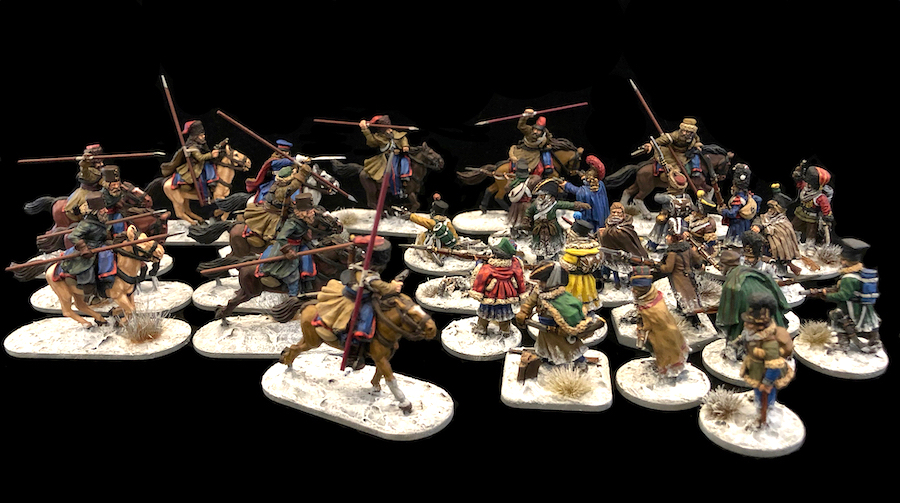
1812 Moscow Opolochenie


Just a wee post this week to keep me honest.

I'm revisiting a project I began a few years ago - Napoleon's 1812 retreat from Moscow. I thought that since we're firmly in Spring's thawing embrace (well, almost), it might be safe to do something that is quintessentially 'winter' in theme.


So here is a trio of Moscow Horse Opolochenie

Who were the Opolochenie I hear you ask?  Sorry, folks, I have no freakin' clue. I only know they're Russian, they look rather cold and they seem to be dead set on doing some righteous (meaning deadly) work. (Postscript: Actually, a blog friend let me know that they were part of the people's militia who fought alongside the regular Russian formations during the French incursion - Thanks Martijn!)

Oh, and they have wonderful hats.


These boys have been sitting half-done on my hobby table for an embarrassing amount of time, so I thought the Quarantine Challenge the perfect vehicle to finally get them done-up and put in the cabinet.

You'll have to forgive me in this last shot. I indulged myself by excavating a few more models from this collection for a 'Duellist' inspired action shot.


Thanks for dropping in!

-Curt


Thursday, March 19, 2020

Dutch Red Lancers


Sarah's Balloon sets me down upon picturesque 'Hawkin's Hill'. Here, our pal Phil asks us to finish something that we've had sitting around for three years or more.

Looking through my out-of-control lead stores, I'm ashamed to say sourcing figures for this task was nooo problem at all, in fact it was more about prioritizing what I should do. Actually, as it turns out, it was no contest at all, as I've had something needing to be done for a very, very long time. So, I present here a regiment of Napoleonic cavalry, but not just any unit, but the 2nd Regiment of Guard Lancers, the 'Dutch Red Lancers' whose uniform is perhaps one of the most beautiful from that sartorially splendid period.


This post is special to me for a few reasons. 


First it's Napoleonic themed, which is wonderful in of itself as Napoleonics were my first 'wargaming crush' and I haven't done a proper regiment for ages. To me, the period is the most beautiful example of Paper, Scissors, Rock. In it, none of the martial arms had complete dominance, making for some very exciting military history, and the uniforms were the perfect blend of ostentatious beauty and brutal function. 

But, for me, the most important aspect of these particular figures is their background.

I received these models 10 years ago as a thank you gift from my very good friend Greg for standing up as a groomsman at his wedding. Yes, this year Linda and Greg will celebrate their 10th anniversary (congratulations you two!) and so I thought it high time to get these figures properly attended to before another decade slips by.

Sarah and I met up with Greg and Linda for a few days during their honeymoon in Paris. During our visit Greg and I spent a wonderful day at the Musee d'Armee at Les Invalides, where I think he became bitten by the Franco-Prussian War bug (such beautifully curated displays, wow). The museum also had a gorgeous example of a Dutch Lancer uniform which, in turn, prompted this gift of miniatures.


While I typically enjoy working on Napoleonic figures I absolutely dread painting cavalry, especially from units as ornate at the Dutch Lancers. True to form, these were complete swine to work on, with all their varied colours and intricate uniform detail. They almost gave me fits. I started them in the first week of the Challenge and barely managed to get them completed for our final run-in. And I still have another dozen of them waiting in the wings! (Earmarked for your 20th anniversary, Greg!) Well, all this being said, I'm pleased with how they turned out and they will be a wonderful addition to my French cavalry contingent. 


As an aside, during the past few days while I've been working on these, I've been listening to Bernard Cornwell's 'Waterloo, The History of Four Days, Three Battles and Three Armies'. I have to say I'm surprised at how crap it was for the most part as I really enjoy his fiction. Sadly, I found it quite derivative of other, better written histories, and on the whole it read as an unabashed Anglo/Wellington love-fest. It was actually pretty hard to take at times. It certainly doesn't hold a candle next to other recent monographs such as the brilliantly written 'Waterloo' by Mark Clayton (which I highly recommend to anyone interested in a balanced perspective of that campaign).


Anyway, forgive my self-indulgent book review. Here are the Dutch Red Lancers, all done and ready to skewer the enemies of the Emperor.

Greg, thank you very much for these wonderful figures! The unit will be a wonderful memento of your wedding and of the great time we had in Paris!


Friday, January 24, 2020

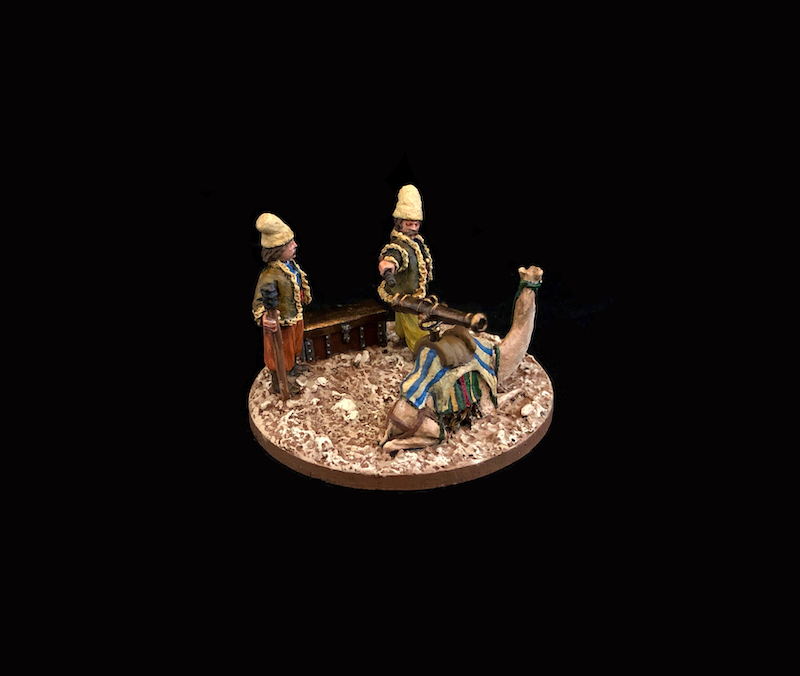
al-Docherty and al-Millsy's Flying(!) Camel Artillery - for 'Docherty's Dock' and Entry #9 for AHPCX


Mu'tamid al-Millsy steps back and grimaces in expectation of the coming catastrophe.' I don't know brother, this seems to be a very bad idea...'


'I think it's brilliant.' Dawood al-Docherty reaches forward with his lit linstock. 'If the thrice-damned French can have flying horse artillery then why can't we have the same, but with camels?!'


'Yes, I understand, but I'm just concerned about the 'flying' part...'


________________________


These figures were from a Westfalia Miniatures Kickstarter for Napoleonic Persians, way back when they were still doing Napoleonics (sniffs in pained remembrance). Wonderful Paul Hicks sculpts. They were an absolute pleasure to work on and I hope they get a smile from Dave and Millsy. Thanks Dave for the location challenge, it was great fun!


Thursday, January 16, 2020

French Aide-de-Camp having a Peek - For 'Piper's Peak'


Hi Everybody!

Today I disembark from Sarah's Balloon onto Piper's Peak. I'm really enjoying using the balloon service as it allows me to work on my usual scatter-shot of projects ('focus is for the weak') and just zip to the location of whatever one I'm closest to finishing. This being said, at this rate I'm going to have enough SarahMiles to journey back to the mainland when this is all over!

Anyway, it's a very nice view from here. Much less congested than some other locations on the island. I hear Sander's Sand Dunes is a bit of a nightmare, what with all the t-shirt stands, red light district and the dodgy 'Island Tour' excursions. ;)


Okay, on to business. Piper's Peak asks us to submit and entry that is:
i) associated with mountains; or 
ii) taking a look (a peek); or 
iii) displaying anger ('a fit of pique')
I decided to go with the second option with a small vignette depicting a group of Napoleonic French aides observing (taking a 'peek' at) their distant opponents


I had done a similar one to this several years ago which I gave away as a gift, but as luck would have it the Perry's double shipped my original order so here I am with a redux version.


While cleanup seems to be a perennial issue with Perry metals I'm still a big fan of these figures. Like so many of their offerings they have such evocative, natural poses that really lend themselves to telling stories. I especially like the fellow with his spyglass braced over his saddle, taking a good long look at the enemy lines. You may not see it in the photos, but he has his boots crossed at the ankles conveying a nice, relaxed pose. Terrific stuff. 

A few people have asked about the bases. Greg and I base our Napoleonic collections on metal sheeting. The corners can be wicked sharp, but it gives a nice, thin profile on the tabletop and allows us to use magnetic sheathed carriers for transport.

This vignette will join the other two sets that I had done up a while back.

A group shot of all the REMFs to-date.
I like using these to help add more colour to the tabletop. I like to place them at the trail of artillery batteries to try convey the formation's greater depth (Yes, I should have limbers to do this, but that way madness lies). Now I just need to do a few more of these for the Brits and Austrians...


Next up is, you guessed it, another balloon trip! Weee!!

-Curt