Showing posts with label 1st Corps. Show all posts

Wednesday, January 12, 2022

Spanish Refugees from Malaga & Dr. Norman Bethune, 1937


Hi All,

Today I return to my Spanish Civil War project with this group of civilian refugees. 

Sarah and I have been fortunate enough to visit both Cebere France and Malaga Spain in previous vacations. Both of these communities are set in beautiful locations, nestled along the Mediterranean coast, but both share a dark history in that they were also sites to horrible events during the Spanish Civil War. I've written about Cebere before, but I've been wanting to do something specific for Malaga for a while now.

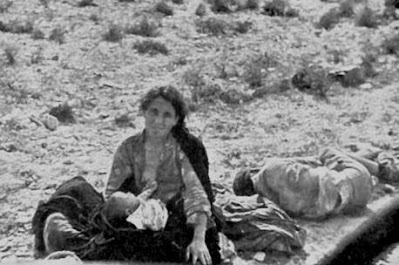
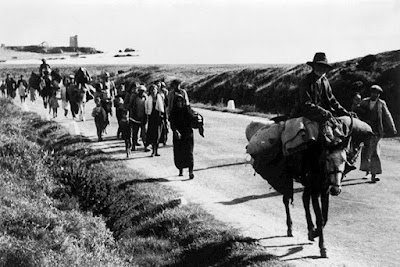
In February 1937, the Mediterranean port town of Malaga found itself threatened by the rapid advance of Nationalist forces. In a state of panic, 120-150,000 people, composed of men, women and children, fled along the coastal road leading to Almeria, 200 kilometers away. In an act of barbaric cruelty, the Nationalists and their Italian allies harried the refugee column for days, submitting it to both air attacks and off-shore bombardment.  Thousands were killed and wounded during the flight, in what many regard as a war crime exceeding that of the infamous bombing of Guernica. 
At this time, a volunteer Canadian surgeon, by the name of Norman Bethune, was working in the area with is independent blood transfusion ambulance. 
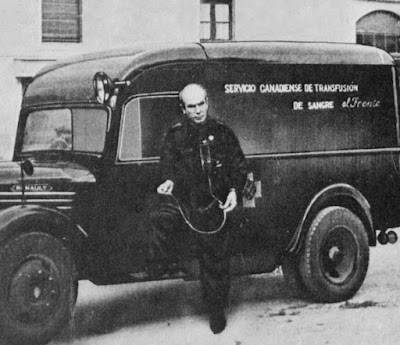
Hearing what was occurring along the coastal road, Bethune and his team quickly drove to the stricken column to give what assistance he could.  For three days and three nights Bethune and his assistants helped evacuate some of the most vulnerable to Almeria, and then provided medical care to the most grievously wounded.

In 2007, the city of Malaga officially honoured Bethune's heroic and humanitarian acts with a commemorative plaque and by naming that portion of the Malaga-Almeria road, Paseo de los Canadienses (The Canadian Promenade). In order to visit the plaque and pay our respects, Sarah and I spent a nice afternoon cycling up to the promenade, situated just a few kilometers outside of Malaga.
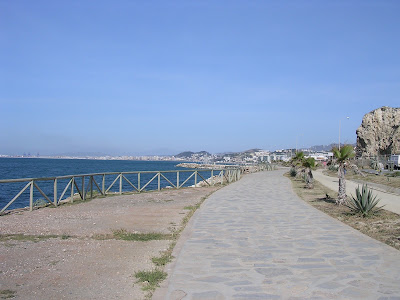
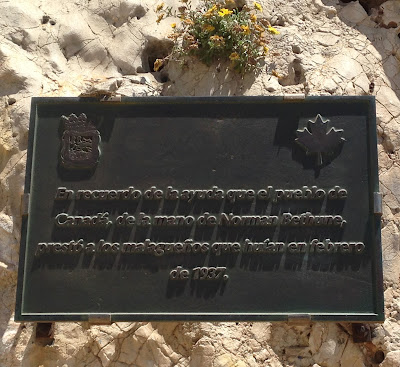
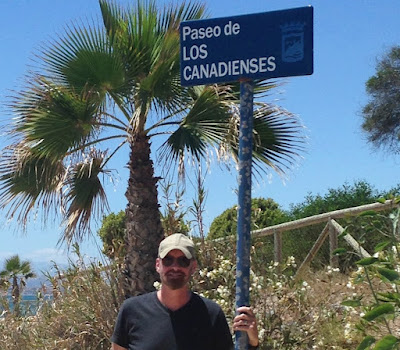
A fine way to spend a wonderful day in sunny Spain.

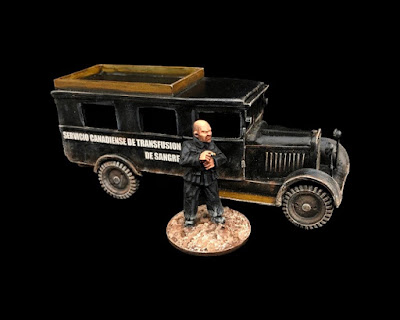
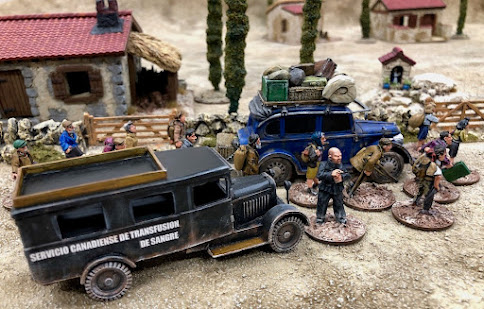
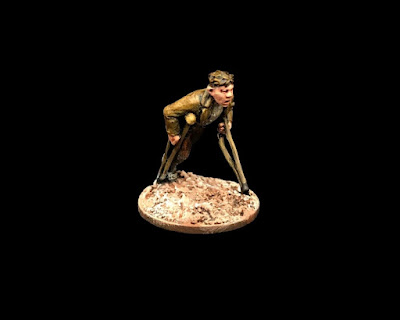
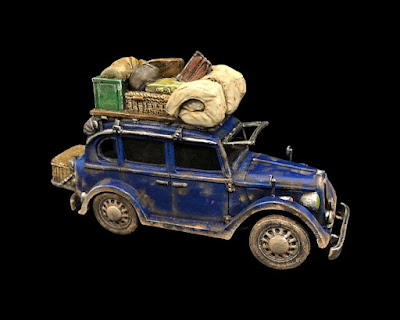
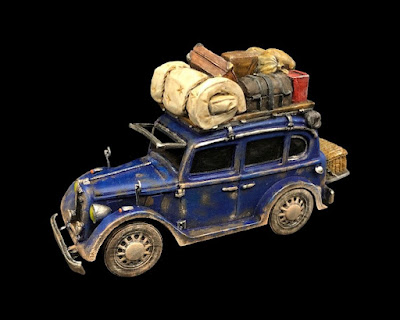
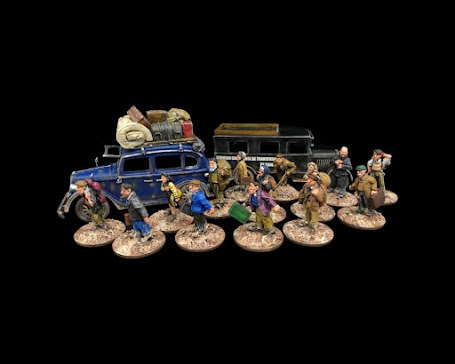
Accordingly, I've done up these figures and vehicles in homage to those events in Malaga. The saloon car and most of the figures are from 1st Corps, the Phenom Granit ambulance is from Empress Miniatures and the poor fellow with the crutches is from Eureka Miniatures. 

My only criticism of the 1st Corps range is that there are not many elderly people, nor any children depicted. I know it's tragic, but I think it is something that should be represented if depicting a refugee column. Maybe they will add some in future releases.
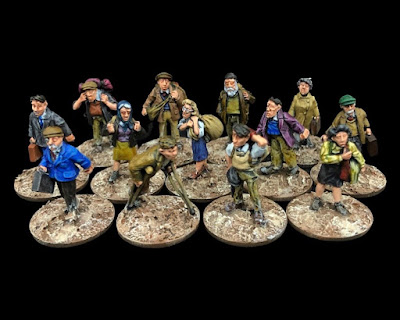
Small quibbles aside, I quite like the 1st Corps figures as they are well-sculpted and very characterful. Even more so is this wounded chap on crutches from Empress Miniatures - a brilliant mini.  
The two vehicles were fun to work on, especially the saloon, with its roof haphazardly overloaded with all manner of assorted household items. You really get a sense of a harried family who have just thrown what they could atop their car and pushed off down the road.
I had to get a bit creative in sourcing something for Dr. Bethune. I ended up using a German officer figure from Artizan which I cut away most of his military detail and modeled some baggy civilian trousers out of greenstuff. Granted, it's a bit crude, but I think it does an okay job at mimicking the good doctor.


Another 'one yard squint' is the ambulance. It's definitely not a close match to Bethune's vehicle, but has the benefit of generally having the right silhouette. 

I really wanted to include the identifying Spanish script on the vehicle's side panel, but my decal-making skills are sorely lacking, so I simply colour printed  what I needed, carefully cut it out, and glued it into place. Again, forgive me in my somewhat clumsy homage. 
Thanks for dropping in and have a great day everyone!

- Curt


Sunday, January 27, 2019

Alastair Grimsby, 'Titus' and 'Bigby' aka: The Big Bad Wolf


Hi All,

Here we have the pugnacious Alastair Grimsby and his mastiff 'Titus', minding their business, tending their flock of sheep, while The Big Bad Wolf (or simply 'Bigby', for those who have read the brilliant 'Fables' series) lopes in for a quick spot of lunch.


Both Alastair and Titus have a great, 'What the f*ck. Again?!' look about them. Alastair, I believe, is an Artizan Design figure, but I can't for the life of me remember where I got the mastiff (pity, as he's a marvellous beast). At first I had them based separately but found that they looked much better side-by-side. I have given Alastair a natty quasi-Burberry car coat, probably a bit too stylish for the Scottish moors, but that's just how he rolls. His original shotgun was a double barrel jobbie, but it was so terribly warped that I removed the barrel and gave him a classically simple Mossberg 500.


Bigby is from Heresy Miniatures. This pose is probably my favourite of any werewolf figures that I've seen. I just love the animation of his feral, loping run. Just an awesome mini. His deeply sculpted fur required a little filling at the joins, but not a real problem. As to painting, I kept it relatively simple and gave him a mottled grey timberwolf look.


The herd of sheep are from 1st Corps. As soon as I saw these online I had to pick one up when we were at Crisis last year. While the overall look is great I have to say that I'm a little disappointed with the amount of bubbles and miscast bits. I corrected a couple things, but finally gave up and just made do. Still, a great looking and versatile tabletop scatter piece that can be used for games ranging thousands of years. 


Thanks for dropping in and have a great week everyone!


Sunday, December 20, 2015

'The Die is Cast - Alea Iacta Est' - My Opening Entry to the 6th Annual Analogue Hobbies Painting Challenge


I decided to open the Painting Challenge this year by following this edition's theme of 'Gambler/Risk-Taker' and creating a command stand depicting Julius Caesar as he is about to cross the Rubicon River, the act which sparked the Roman civil war. You can see the rest of the post here on the Challenge blog.


These 28mm models are from 1st Corps. 


I found some replica Roman dice on Ebay. They just arrived in time for the assembly. I gave this one an Devlan Mud wash to antique it up a bit.


Again, please drop by the Challenge Blog to keep tabs on the goings on there. We have 88 participants from all over the globe this year so there's always something interesting to see and read.

Next Up: Something Milanese...

Curt Out.

Thursday, August 9, 2012

The Great War in Greyscale - German Sniper, 'Lover of the Dead' Inspired by the novel 'Three Day Road'


In Joseph Boyden's fine book 'Three Day Road', two young Cree indians from the forests of Northern Ontario volunteer alongside other Canadians to fight in France during the Great War. Once in Belgium the two men, having impressed their officers with their marksmanship and fieldcraft, are taken from the line and trained as snipers. Very deadly snipers.


Boyden's fictional Cree marksmen were inspired by a real First Nation's sniper, Francis Pegahmagabow, who was known in the Canadian trenches simply as 'Peggy'.


'Peggy', an Ojibwa from Ontario, became one of the highest ranking snipers in military history, being credited with 378 kills including over 300 captures. He was seriously wounded twice and was three times awarded the Military Medal for gallantry under fire. Pegahmagabow survived the war and later became chief of the Wasauksing First Nation. He remained an agitator and First Nations activist until his death in 1952.

One section of 'Three Day Road' describes a harrowing sniper duel which occurs in No Man's Land between the Cree marksmen and a notoriously successful German sniper. I don't want to give too much away from the book, but one chilling aspect of the German sniper's method is that he sets his firing position amidst the corpses between the lines - literally positioning cadavers around and over his body to provide camouflage and protection.

Can you imagine? Elijah asks, beginning to laugh. The intensity of such a man? He could lie there for hours among the dead and rotting. He lay there in that stink of death like death itself (...), a lover of the dead.

This vivid image from the book made an impression with me and so I decided to create a small vignette depicting the German sniper, laying in wait, set-up in his macabre firing position. 


The base is made up of a mixture of figures from Brigade, Great War and 1st Corps. I cut one of the casualty figures in half, repositioned and puttied it to allow it to properly drape over the sniper's body. I added a little surgical gauze around the sniper's rifle to mimic the camo scrim some marksmen used to reduce reflection. I bent some brass rod to resemble the barbed wire hangers that were common to the frontlines and then added some wire to give the impression that the sniper had cut the wire to lower the body over him.


I painted the sniper and groundwork in greyscale but chose to depict the dead in colour - a German Landser, a French Poilu and a Belgian Carabinier. 


Three Day Road

Joseph Boyden

Penquin Group

ISBN: 0143056956

Monday, July 23, 2012

The Great War in Greyscale - Belgian 'Minerva' Armoured Car


The Belgian army of 1914 was quite ill-prepared for a general European war. Its army was relatively small, indifferently equipped and not well-respected even by its own population. To further compound this general malais the Belgian armed forces had no defined set of war plans to provide a strategic focus in any prospective war. Granted much of this can be explained by the unique political position Belgium held at this time. As being a guaranteed neutral power it had to contend with the possibility that any of its neighbours could be a potential hostile force. (Indeed, some of France's pre-war planning seriously entertained the idea of violating Belgian neutrality in order to deny the Germans that avenue of approach.) So instead of having several plans to meet a variety of contingencies Belgium simply chose to have none.