Showing posts with label Wargames Foundry. Show all posts

Monday, January 4, 2021

Czech Paratroopers from 'Operation Anthropoid'

Here are figures representing the Czech paratroops, members of 'Operation Anthropoid', who were trapped and killed in the Church of Saint Cyril and Methodius in Prague on June 18, 1942.

My grandfather was raised just outside Prague and emigrated to Canada when he was a boy. In around 1940 he received a draft notice from the German-controlled Czech government  calling him 'home' to serve in the army. Being a new Canadian he pointedly ignored it. When I was a teen he told me of the Czech patriots that killed Heydrich along with its heavy cost. Being young, I really didn't know much of what he talked about, but I knew it made him very sad and yet proud. It wasn't until I watched the excellent movie 'Anthropoid' a few years ago that I understood what this event may have meant to him.

Poster from the 2016 film


As a bit of background, 'Operation Anthropoid' was a Special Operations Executive (SOE) mission whose objective was to assassinate SS Obergruppenfurer Reinhard Heydrich in Prague in the spring of 1942.  

Heydrich was the head of the SS security service and was the Reichsprotektor of Bohemia and Moravia. In addition to being soullessly ruthless (he was the chief architect of 'The Final Solution'), he was also regarded as a brilliant administrator and a savvy politician. His influence and position within the Nazi party made him an obvious target for the SOE, who wanted to make the point that any Nazi leader, no matter how powerful, could be found, targeted and killed.

In light of the despondency and acquiescence of many Czechoslovakians to the 1938 German occupation, the Czech government-in-exile was eager to show its commitment to the overthrow of Nazi Germany. They wanted to be seen as active participants in the war, and were enthusiastic to be involved in a bold strike to salve their national pride and bolster their credentials in any postwar reconstruction.

As such, a team of SOE-trained Czech paratroopers were dropped into Czechoslovakia, and after several setbacks and false starts, succeeded in fatally wounding Heydrich while he was being driven to work in his open-topped staff car.

Heydrich's staff car after the attack. Note the bomb damage on the rear running board.

The Czech commandos were given sanctuary in the Church of Saint Cyril and Methodius. Nonetheless, their hiding place was ultimately discovered by the SS through torture and treachery. 

Approximately 750 SS troops laid siege to the church. They tried numerous times to simply force an entry, but were bloodily repulsed. After several hours of fighting they managed to force the surviving paratroopers down into the lower crypt. The SS then used tear gas and then began to flood it from firetrucks brought to the scene. Recognising that their situation was hopeless, the last remaining paratroopers committed suicide rather than being captured.

Memorial plaque at the Church commemorating the Czech and Slovak paratroopers killed in the siege and the church's clergy who were subsequently murdered by the Nazis. 

As expected, the reprisals for the assassination were swift, brutal and without any sense of proportion. The Nazis arrested thousands, and the villages of Lidice and Lezaky were effectively wiped from the map. It is estimated that approximately 5000 civilians were murdered by the SS, with many being interred and later executed in concentration camps. The clergy from the church where the paratroopers were hidden were summarily executed. 

The believed necessity of Heydrich's assassination weighed against the resulting reprisals is something which is still debated today - it certainly isn't an easy question to rationalise or square with. Yes, 'The Butcher of Prague' and the architect of the Final Solution had been brought to justice. It did cause the Nazis to increase security in their rear areas, which meant less troops serving at the front, and it did steel the Czech's will against their occupiers, but the cost of these gains was so very high that it brings into question the decision to mount the operation in the first place.

__________________________________

The majority of the figures I used for the paratroopers are 28mm partisans from Artizan Design and Wargames Foundry. Nice, simple and characterful. 


I used fairly large bases with sloped sides so I had space to paint in the names of the seven paratroopers. My script is a little off here and there, but it serves alright.


Sorry for the rambling history lesson, but thank you for dropping in!

-Curt 

Wednesday, December 30, 2020

Gentlemen Adventurers for the Great Siege of Malta

Today I'm revisiting my 1565 Siege of Malta project. I started work on this collection last year and I thought it high time to add another unit to the defenders.

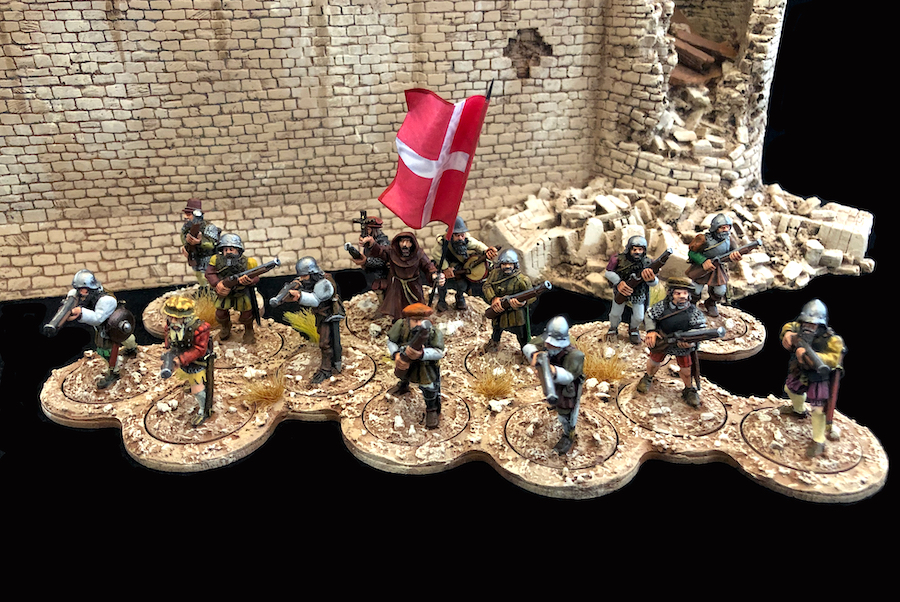
These hard-bitten arquebusiers represent a group of Christian 'Gentlemen Adventurers' who played a significant role in the Great Siege. These were essentially companies of Spanish and Italian mercenaries, drawn to the Siege through the winning combination of base avarice and religious zeal. They made up a good portion of the defenders, outnumbering the well known Knights of Malta several times over. I have an impassioned priest trying to keep their bodies and souls focused on killing Ottomans for the Faith. (The barbaric actions of both the Ottomans and the Christian powers in the Middle Sea is not really a great endorsement for organised religion - but I digress.)

These figures are from Wargames Foundry's El Dorado range, sculpted by the talented Mark Copplestone (his models seems to be an unintentional theme for me these past few weeks). Like the rest of my Malta stuff, these are based up individually as I envision the games will be more skirmish based.

Nonetheless, wanting players to be able to move their groups quickly, at least at the onset of the game, I had Byron cut up some sabot bases that I had I sketched up. I designed this one to indicate skirmishers, or missile troops, spread out in a loose formation. Players can have the command stand at the front or the rear to suit their aesthetic sensibilities.

A brave and righteous man of the cloth leading from the front...

...or one with wee less conviction.


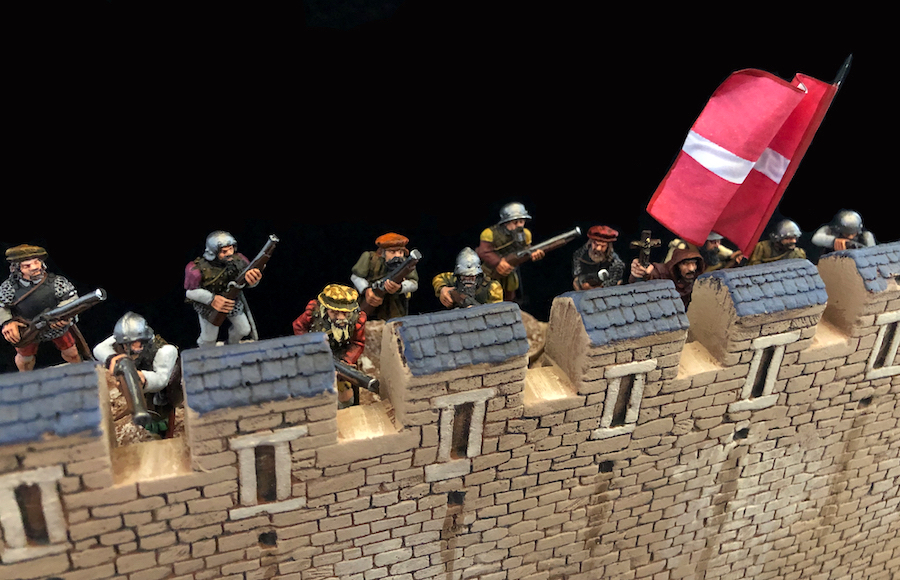
As you can see, I'm amortising the use of my Vatican Enterprises walls with a cameo appearance here.

Out of their sabot bases and manning the walls.

Next: Something from WWII

-Curt

Sunday, March 22, 2020

Maltese Militia, 1565


The 1565 siege of Malta is often seen as a contest purely between the Turkish Ottomans and the Knights of St. John. Nonetheless, the realities of the campaign were much more complex and interesting. 

The 40,000 man Ottoman host was not only composed of Turks, but also drew upon the many ethnicities from its sprawling empire. Greeks, Bulgarians, Algerians, Libyans, all along with a smattering of coastal corsairs and assorted religious fanatics were allied with the Turks laying siege to the island. This provides a veritable feast of character and colour for hobbyists to represent on the gaming table. 

Also surprising (well, to me anyway), was that of the 6,000 defenders, the Knights themselves only made up about 500 of their number. Another 2000 were composed of marooned Spanish sailors, along with various companies of 'Gentlemen Adventurers' from Italy, Spain and Greece. The largest contingent of defenders (at least half of the total number) was made up of the humble Maltese themselves. 

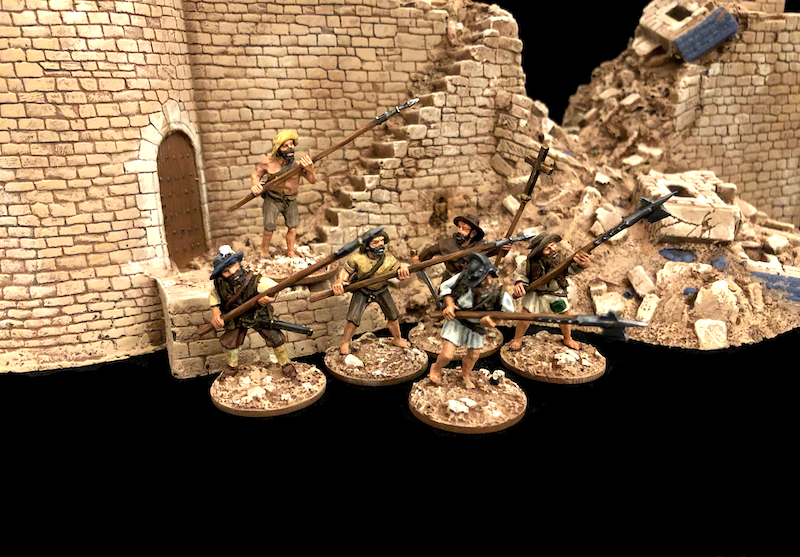
A small number of the Maltese would have been previously trained as militia, whereas the vast majority were simple island folk, rising in defense of their island. A few of them would have had the means to possess a studded shirt and a morion helmet, but a large proportion would have fought in their civilian dress, bare limbed, indifferently armed and reduced to mere rags by the end of the siege.

The histories indicate that the Maltese were often organized into large units with a Knight or soldier of fortune acting as their leader. Several accounts depict their local priests and women sharing the risks with them.


Gaming wise, one can find many suitable figures for the Knights and gentleman adventurers, but no one that I know of that has a range of figures which specifically depict the Maltese militia. Nonetheless, like the brave Maltese themselves, there are good proxies out there that can be pressed into service. The best figures that I've come across are the Portuguese Conquistador range from Eureka Miniatures. They are wonderfully sculpted and hit the highlights of what I think a Maltese fighter would look like: bare legged, lightly armed, scruffy and most importantly: scrappy.


Eureka Conquistadores
Common weapons amongst the Maltese would have been half pikes, short swords, long knives with maybe a smattering of firearms, bows and crossbows.


A couple other figures I pressed into service (a Foundry German barbarian (left) looked just fine for a slightly hirsute Maltese)
Undoubtedly the most powerful weapons in their arsenal would have been the incendiary devices which they created in an attempt to fend off the large masses of Ottoman infantry. 

One of these were the use of pimkins, basically earthenware jars filled with an incendiary concoction (some sources say Greek Fire) with a simple fabric fuse. A rudimentary grenadoe, these pimkins would be thrown into the Ottoman ranks in the hope that they would shatter and catch fire upon impact. 

Another weapon, quite ingenious in its brutal but effective design, was the use of reed hoops that were coated with an incendiary paste. The hoops would be lit and then, using long tongs, would be thrown, or rolled towards the Ottoman formations. This weapon was  particularly nasty as it would entangle the legs and long robes of the Ottomans during their advance, causing havoc in the ranks.

I made a rendition of the burning hoops by coating a circle of florist wire with texture gel and teasing it to look, well, sorta flame-like. I made a set of them laying flat on the ground and another set with them rolling along like demonic hula-hoops, which while neat looking is probably a bit fanciful. 


Finally,  the Maltese also employed what was called the 'Trump' (I know, really...). Not much detail is recorded regarding these weapons, but it is understood that they were hollow tubes filled with incendiary fluid mounted on half pikes. 


When lit, they would gout out flames for 2-3 meters, like a crude, short-burn flamethrower. Unreliable and incredibly dangerous to friend and foe alike (and so quite appropriately named), these would be used to block off weak points in the fortifications, or in point defence to help turn back Ottoman assaults. 


Flame effect made from a 3D print.
I also picked up a few wall sections from Vatican Enterprises to represent the walls of the various Maltese strongpoints. 


Though they are not a perfect match to the Hospitalier designs (which were more blunt and angular) I think they do a good job in conveying the overall sense of the fortifications of the island, and could be used for gaming other historical periods as well (Constantinople, Vienna, Badajoz, etc.).


I especially like the damaged sections as I think they will provide great set-dressing for a a wide assortment of breaching/sally scenarios.


So there you have the beginnings of my Maltese militia, along with a bit of terrain for them to defend.

Thanks for dropping by!

Curt

Monday, February 4, 2019

Renaissance French Pike ('Mauvais Garcons') and Great Gun


The French, with a few notable exceptions, were not especially renown for fielding effective pike formations. Where the Swiss cantons and German landsknechts had the pike market pretty much sewn-up, the French expertise lay more in their heavy cavalry and artillery. From reading David Potter's 'Renaissance France at War' it was not uncommon for inexperienced pike French formations to acquire foreign mercenaries, who, being more seasoned in the profession of arms, helped steady the ranks. 

The French liked to muster their troops from particular provinces or townships, which gave each unit a bit of 'local colour'. For example, men from Picardy, led by the reported libertine Mssr. Monclou, were known as the mauvais garcons (literally translates as 'bad boys). A bit of a rude chap himself, Monclou was executed in 1523 for his 'depredations' during campaign (not especially surprising when your employer is the Pope, but there you have it).

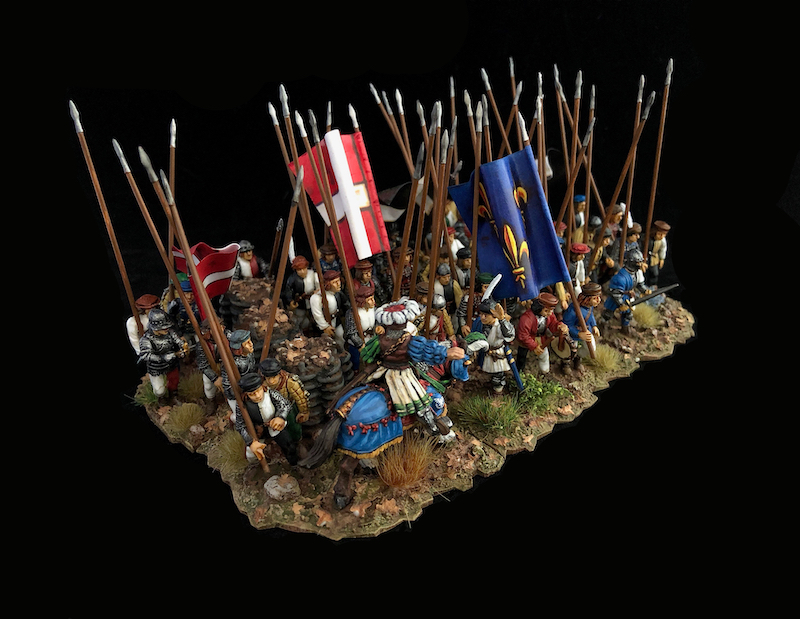
Last year, my good pal Millsy was kind enough to paint up a schwack of Perry plastic pike for me so I could field another unit for my Italian Wars collection. After the hurly-burly of the summer, and being distracted by other projects this autumn (I'm looking at you 'Titanicus'), I finally managed to get this mob flagged, pimped-out, and based-up to roll with my other units.

My contribution to this mob is sole mounted German mercenary at its head. This is a Perry-sculpted figure from the Wargames Foundry range of Landsknechts. I love these figures as they are so wonderfully characterful and satisfyingly hefty. The Perry's did such a great job in sharply defining the puff-and-slash of the clothing, which makes them a real joy to paint.


It always seems to take me an age to get the figures placed in some kind of sensible arrangement, and since I like having my pike blocks bunched in quite tight, I found that I was a few figures shy to fill all the bases. Not a problem! I estimated the space I needed to absorb and then printed off a few gabions on the handy-dandy 3d printer. In the end I'm happy with the overall look of the unit, slightly broken up, weaving their way around a line of light fortifications.


Both of these units I've based in an autumnal theme to match with the rest of my Italian Wars stuff. (Thankfully I keep a 'hobby recipe book' as I have a bad habit of bouncing between periods and always, always forget how I did things - so it helps keep things straight in my noodle.)


Millsy also painted me a trio of gunners as gift last year. And so like the pike, I've been holding on to these until the Painting Challenge to get them matched up with an appropriate gun (this one from an old chestnut from Warhamer Fantasy). As I had a spare gabion left over from the pike unit, I popped it on the base for a bit of visual interest.


I want to thank Millsy very, very much for the brilliant figures - they're a wonderful addition to my Italian Wars collection. Thanks again mate!


Cheers for dropping by folks! I hope you all have a great week.

Tuesday, February 6, 2018

Entry #11 to AHPC: 'An Alpine Duet' - Italian Wars Swiss Alphorn


It was a bit of a scramble for me this week, but I've come up with a vignette that I've been wanting to do since I began my Italian Wars project a few years ago: a Swiss alphorn player calling out to his reisläufer camarades. 

A very unique instrument, the alphorn has its roots extending back to antiquity, with theories believing that it originated with the lituus war horn from the Etruscan period.  Early medieval alpine myths frequently refer to the horn being used as a signalling device between mountain villages, while the first documented reference of the word 'alphorn' is in a 1527 account book of a Cistercian abby, where an alphorn player was paid two Batzen for his playing (or perhaps to stop).


So with this in mind, I've extrapolated that if the alphorn was a fairly common instrument amongst the Swiss from at least the early medieval period, one could conjecture that they would have used them in their military campaigns, for signalling purposes and, like the highland pipes, to raise the morale of their fighting men.


As there are no alphorn figures in the market (a shocking oversight, I know) I made my own by bisecting the torso of a Perry Swiss musician, removed his existing instrument, and reposed him (aided with a liberal amount of wire and green stuff) to accept his 10 foot alphorn.  


The alphorn itself was made from a length of plastic rod with greenstuff wrapped around it and then sanded to shape.


For a bit of fun, I've accompanied the alphornist in a somewhat mismatched duet with a Landsknecht flautist, while a few onlookers are taking in the concert, enjoying a refreshment. 

Take it away!


Song: 'Heart of Cairo' (2013)

Artist: Eliana Burki

Wednesday, August 30, 2017

Spanish Civil War Figures for Nick and Christopher


During our last Painting Challenge I had a fun brush duel with Nick, Christopher and Phil to see who could paint the most points of Spanish Civil War figures. I really thought I had it in the bag by establishing an early lead, but Nick took the prize in the last few weeks with a tremendous entry which, try as I might, I couldn't manage an effective riposte. Well done Nick!

So, here I present my tribute figure to Nick for his well-fought win: a Republican dinamiteros preparing to throw his pipebomb IED. 


This figure is from the excellent Empress range. 


I'm also sending along a LMG team as a belated reply to our Annual Friendly Figure Swap.


These guys are from Wargames Foundry's French partisan range which I think work very nicely for Republicans. If you squint a little, the Bren becomes a period appropriate Czech ZB vz 26. :)


AND for Chris, a Canadian standard bearer from the 15th International Brigade for being such a great supporter of the Challenge all these years.


Again, another Empress figure. He's carrying the Mackenzie-Papineau Battalion colours


I'll be following up with a figure for Phil in a few weeks. That one I plan to hand-deliver later this autumn when we visit Crisis in Antwerp (SO excited). Now, how's that for service!

Next Up: An AAR from our '43 Italian campaign

Sunday, August 6, 2017

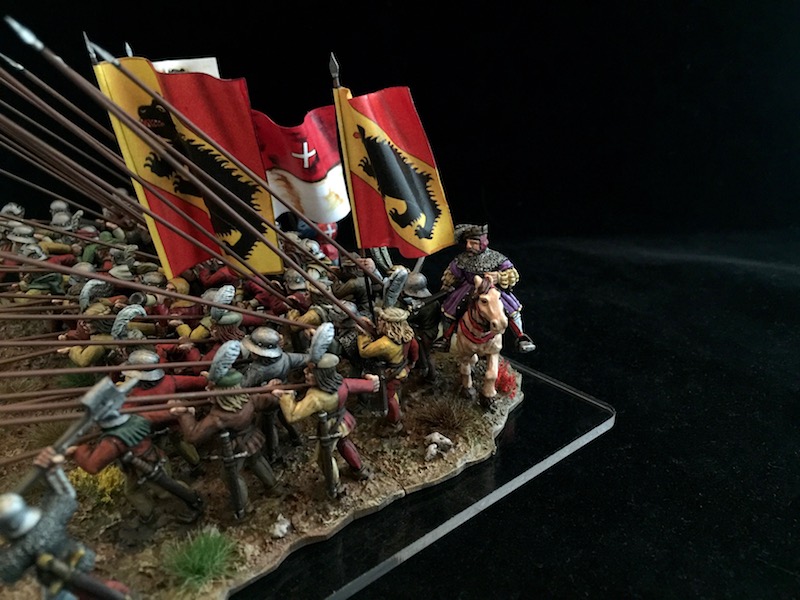
Italian Wars Swiss Pike from Bern, Appenzell and Solothurn


Yooray! Another unit added to my Italian Wars collection. This time out we have a mob of Swiss pikemen from the cantons of Bern, Appenzell and Solothurn. 

The majority of figures from this unit were commissioned from the very talented John over at Jacksarge Brushes & Battles. 

Usually I prefer to paint my own figures, but I wanted to get this collection to a playable state sooner rather than later, so I've enlisted some help from a few pals from around the globe to assist me in getting them done.  I've already blogged about Brendon's Spanish jinete light cavalry and Chris' Lucerne pike; well, later this year you will see some work from two other paint condottiere whom I'm very happy to have as friends. I'm not going to let the cat out of the bag until they're all done and based-up - so more on that later.


As I enjoy doing the composition, banners and basework, I had John focus on painting the figures and I'd take care of the rest.


I actually received these figures around a year ago, but the Painting Challenge and other projects sidelined me from getting them properly based-up until this summer.

As you can clearly see John does beautiful work. I'm very, very pleased with them. 


These figures are Perry Dave Andrews sculpts from Wargames Foundry. While they are a little long-in-the-tooth I find that they are really lovely castings; nicely proportioned and conveying a wonderful sense of movement. 


To be honest after my Landsknecht pike I wasn't really keen on doing another formation in a charging pose as they are complete swine to base and take up about twice the space as a regular unit, but I couldn't help myself when I came across these models while browsing the WF catalogue. Oh well, I reason that these levelled-pike units can be used to denote veteran or particularly large-sized units so I'm okay with having a few in the collection. 


I painted up a few more models to help round-out the unit. There's a standard bearer buried in there that's mine, the horn player, the mounted hauptmann overseeing the lads and the poor landsknecht out in front, having a little lay-down.


The banners are from Pete's Flags


In this last shot you see the pikeblock being screened by a unit of Bernese halberdiers and led-in by their mascot, 'Daisy'.


Next Up: A couple of Big Guns for the Mechanicus.