Sunday, January 4, 2015

28mm Russian Civil War - Czechoslovakian Volunteers from the Kornilov Shock Regiment

(My apologies for the cross-post from the Challenge blog, but this one does have a few more pics for what it's worth.  :) )


In response to Miles’ request to provide pictures of our various hobby spaces here is a shot of my nerve center (or is that 'nerd center'?). 


Yes folks, it’s literally a closet, so no snarky remarks… :) We're pretty draconian about having a fairly minimalist household (I should’ve prefaced this by saying we have no kids). We try to keep things pretty spartan around the place, but our book collection and my hobby stuff frequently pose a challenge. So I created this ‘hobby closet’ in our media room in order for me to keep my hobby rig set-up while still having the ability to close the doors in order to keep the room looking neat and tidy. 

I know, it's a little OCD, but I'm okay with it (rocks back and forth repeatedly...).

Anyway, I’ve got about half a dozen hobby projects all on the go right now, which I must say is making me a little mental. Most of them are waiting for ‘that one essential thing’, a decal, a flag or some other infuriating detail that I’ve convinced myself that I absolutely need to properly wrap them up. Now, if I can get some of this stuff wrangled I should be able to get back on track towards my points target but right now it's pretty much a complete gong show.

Nonetheless, from all this chaos, I’ve actually managed to finish something to the point that I can submit it!  Woohoo!!

Continuing on from my Tachanka, this is another entry which focuses on the Russian Civil War. 


I find this period of history fascinating as there were so many personalities and groups involved in the conflict. Russians, Latvians, Finns, Poles, Ukrainians, the list goes on and on. This submission is about a small portion of the Czechoslovakians who fought in Russia during the Civil War.

I was quite close to my grandparents on my mom’s side. Granma's family was Austrian and Grampa was from the outskirts Prague. Gramps, while being a fervent new Canadian was also very proud of 'The Old Country' and took great delight in telling me stories of Jan Hus and his Hussites, and of the ‘Czech Legion’ which fought the Reds and helped to secure Czechoslovakian independence. When he told me about the Czech armoured trains and the fact that the Legion itself controlled thousands of miles of Russian railways I was a little dubious, thinking he was pulling my leg. Later on, when I was in university, I read more about the Czech Legion and discovered that truth is indeed sometimes stranger than fiction.


This squad represents some of the Czechoslovaks who volunteered to serve with General Lavr Kornilov’s forces. They became part of the famous (or infamous) Kornilov Shock Regiment which was considered very dependable amongst the White forces and was composed of some pretty hard, hard men. Suffice it to say that not many of these guys survived the Civil War but apparently a few made it back to the new state of Czechoslovakia and probably had some harrowing tales to tell I’m sure.


These models are almost all from Footsore Miniatures (previously Musketeer Miniatures) while at least one is from Copplestone Castings. All of them are excellent figures, easy to prepare and a real joy to paint. 

Even though the traditional uniform of the Kornilov Shock Regiment had the men in red caps I decided to keep these lads in a mix of headgear to show them as separate volunteers. I also painted in white-over-red cockades for their caps and right breast as that was the chosen colours of the Czechloslovakians fighting in Russia.


One thing some may notice is that there are a lot of white flowers on these bases. I thought that since the basic uniforms in the Russian Civil War were often very similar to one another I’d have the white flowers signifying White troops and, you guessed it, red flowers for the Red forces. Dorky I admit, but I think it will make things easy to decipher when they’re all mixing it up on the tabletop. (In fact I think I’m going to use the same idea for my upcoming Wars of the Roses stuff…)


I’m not sure what I’m going to actually do with this these guys. To be honest I'm collecting this period in both 15mm and 28mm. Yep, nuts I know, but I really like painting the detail of the bigger castings from Footsore and Copplestone, while also loving the little 15mm cavalry and armoured trains from Peter Pig. I’ll probably do up enough to use for ‘Chain of Command’ and perhaps some Pulp gaming as well, other than that I have no clue. But I guess that’s the fun of it all!

Friday, January 2, 2015

'Papa' - Bernez Carro - Brother, Soldier, Father & Smuggler

(Please excuse this cross-post from the Challenge blog)

This is a continuation of my background story of the Carro family which began a few weeks ago with a description of the older son, Donon


It was April 1916 and Bernez and Briec Carro were almost 20 years old when they marched down the Voie Sacree (the ‘Sacred Way’), to the inferno of Verdun. When they arrived at the front lines the twin brothers were assigned to different companies in order to reduce the chance of hard news for their mother. Nonetheless, the young men were inseparable and so they worked a few favours to get themselves assigned to the same squad. For the next few months they endured ferocious fighting in conditions that are best described as bestial. During this time they found that their own officers treated them and their comrades like cattle and so the brave Poilu died by the thousand.

On July 12th at Fort Souville the Carro bothers were part of a forward listening post that became overrun by a German assault unit armed with flamethrowers. Knowing what was about to happen, Briec pushed Bernez into a sodden shellhole and took the full brunt of the liquid fire. Made into a human torch, Briec died horribly. The water in the shellhole saved Bernez's life but was not deep enough to cover all of him so half of his body was lit aflame. After the German attack faltered and was beaten back Bernez was found and sent to an aid station in the rear. He had suffered severe burns to the left side of his body and so for him the war was over. 


Bernez was invalided out of the army and he returned home to Brittany to convalesce. His childhood sweetheart, Manon, looked past his burns and insisted that they immediately marry. Donon, their first son, was born nine months later and Briec, their second boy, a year after that. In 1918 Bernez and Manon took over the family fishing business. Soon after his cousin, Lois from Marsailles, convinced him to expand into smuggling and so the Carros began to flourish. When their sons became old enough they were brought into the business as partners.


In the years following the Great War Bernez has nurtured an understandable dislike for Germans, but most of all he hates officers – all officers. It does not matter what nationality: German, French, Spanish, he despises all of them. So when in the summer of 1936 Spain’s right-wing generals, with the help of Nazi Germany, staged a coup to overthrow the Republican government, Bernez sees an opportunity to not only make a lot of money but also, in a small way, to poke his finger in the eye of those he reviles.


Bernez is a figure from Lead Adventure’s post-apoc range. I shaved off his left ear, scored his face and painted his burn scars a livid purple/pinkish tone. I really like the pose of this model. He’s a commanding figure, straight-backed and taciturn but leans forward somewhat, stiff-jointed, like many middle-aged men do. He holds a Luger behind his back just in case matters go awry. I painted his coverall trousers yellow in order to tie him in with the figure of his first son, Donon.


Sunday, December 28, 2014

28mm Russian Civil War 'Tachanka' Machine-gun Wagon


Season's Greetings Everyone!

First, just a short note to let you all know that the gallery for the second theme round of the Painting Challenge is now up in all it's glory and awaiting your viewing pleasure.

This week's theme is 'Rider(s) & Mount(s)' and as such I decided to debut a little side project of mine which will concentrate on the various colourful units and personalities of the Russian Civil War.


So, what you see here is a 'Tachanka' machine-gun wagon which were heavily used in the open expanses of the Southern Russian and Ukrainian fronts. With motor vehicles being almost non-existent at the time, and in this part of the world, it seemed only sensible to make good use of the abundance of peasant wagons and horseflesh.


It is believed by some that the name 'Tachanka' derives from the Ukrainian diminutive nickname for 'wheelbarrow'.)

These small wagons would typically be drawn by two to four horses, have a crew or three or four and be armed with a heavy machine-gun positioned to fire from the rear of the vehicle. From my understanding their tactics would be to set up in ambush and then scoot to a new firing position once things got too hot or scamper out of harm's way using the machine-gun for covering fire. (I've read of Tachanka 'charges' but these seem rather harrowing considering they would have to approach the enemy positions at the gallop and then turn around to bring their guns to bear, all the while being under enemy fire.)


This is a 28mm kit from Eureka Miniatures. It provides a wonderful build, virtually flash free with no discernible imperfections to the castings. My only caveat is that the figures are quite small to really be listed as 28mm, rather I found them closer to 25mm or perhaps 22mm. Nonetheless, the completed model still looks great and fits well enough with the rest of my collection. I've painted the crew up as Cossacks but the kit comes with another variant to have them as Red crewmen with the distinctive (if somewhat dorky) pointy 'shlem' hat.


In terms of using a Tachanka in 'Chain of Command' I'm considering using these modified rules:

- a Tachanka is classed as a fast, softskin fighting vehicle;

- for game terms it may not reverse;

- unlike normal fighting vehicles a Tachanka can be deployed from a Jump Off point to reflect their tactical doctrine of being used for ambushes;

- they can be deployed in light woods;

- as a Tachanka is open topped it has the sighting capability of an infantry unit, so they have no spotting limitations; 

- when stationary, a Tachanka fires as a top-mounted HMG at full rate of fire (10 dice) but when moving it is halved (5 dice) due to the bouncing and jostling of the highly sprung carriage;

- it is completely unarmoured so is targeted as a softskin;

- as a target it is not rated as a small target or low profile BUT when moving it always receives a -1 target modifier to reflect its evasive maneuvering (if moving in a non-urban setting);

- when hit, the horses are counted as valid targets along with the crew;

- each horse killed reduces the top speed by one dice to a minimum of 1 dice;

- a dead horse dragging in the traces slows the wagon by -2 pips on the movement dice. The carcass will need to be cut away from the traces in order for the wagon to move at its proper rate. Cutting a dead horse away takes an action to perform.

Tuesday, December 23, 2014

Legend of Drizzt Christmas

Hello dear readers of Analogue Hobbies. I would like to start off by thanking Curt for allowing me to hijack his blog for this post so I can share the story behind this special Christmas gift to my brother. I’m JeremyM, a member of Curt’s local gaming group and a past and present painting challenge participant.

Anyway this year I decided to give an extra special gift to my brother Jonathon. Jonathon is a pretty amazing guy. He is a medic in the Royal Canadian Regiment stationed in Petawawa Ontario, and a veteran of Afghanistan. Last year he married a wonderful local girl, Jen, and became the father to her beautiful little boy Jack. Now they are expecting another little boy on January 9th, 2015. We really can’t wait to meet the new addition!

Jonathon and I were quite different growing up. I was always a book worm, and he was much more into sports. I had tried to get him into some of the sci-fi and fantasy books I was absorbed in, but none really took. That was until I introduced him to R.A. Salvatore’s Drizzt character in the Dungeon and Dragon’s Forgotten Realms books. He became completely hooked and read everything he could get his hands on about Drizzt.


To my pleasant surprise, I discovered a board game “The Legend of Drizzt” I decided to purchase the game as a gift to him. However, the minis were rather drab plain plastic, so these past couple of months I decided to paint everything up for him and the results are below.

Drizzt and his panther companion Guenhwyvar


The other heroes left to right. Athrogate, Cattie-Brie, Wulfgar, Regis, and Bruenor Battlehammer
I recognized a few of the characters from some of the older Drizzt books, but I haven’t kept up with the more recent ones and had to do a bit of guesswork on how some should look. Hopefully, the colour scheme’s I chose work alright. Because Jon has a toddler and a baby on the way, I also put several coats of varnish on with an airbrush to hopefully protect the paint jobs from the playfulness of his two boys.


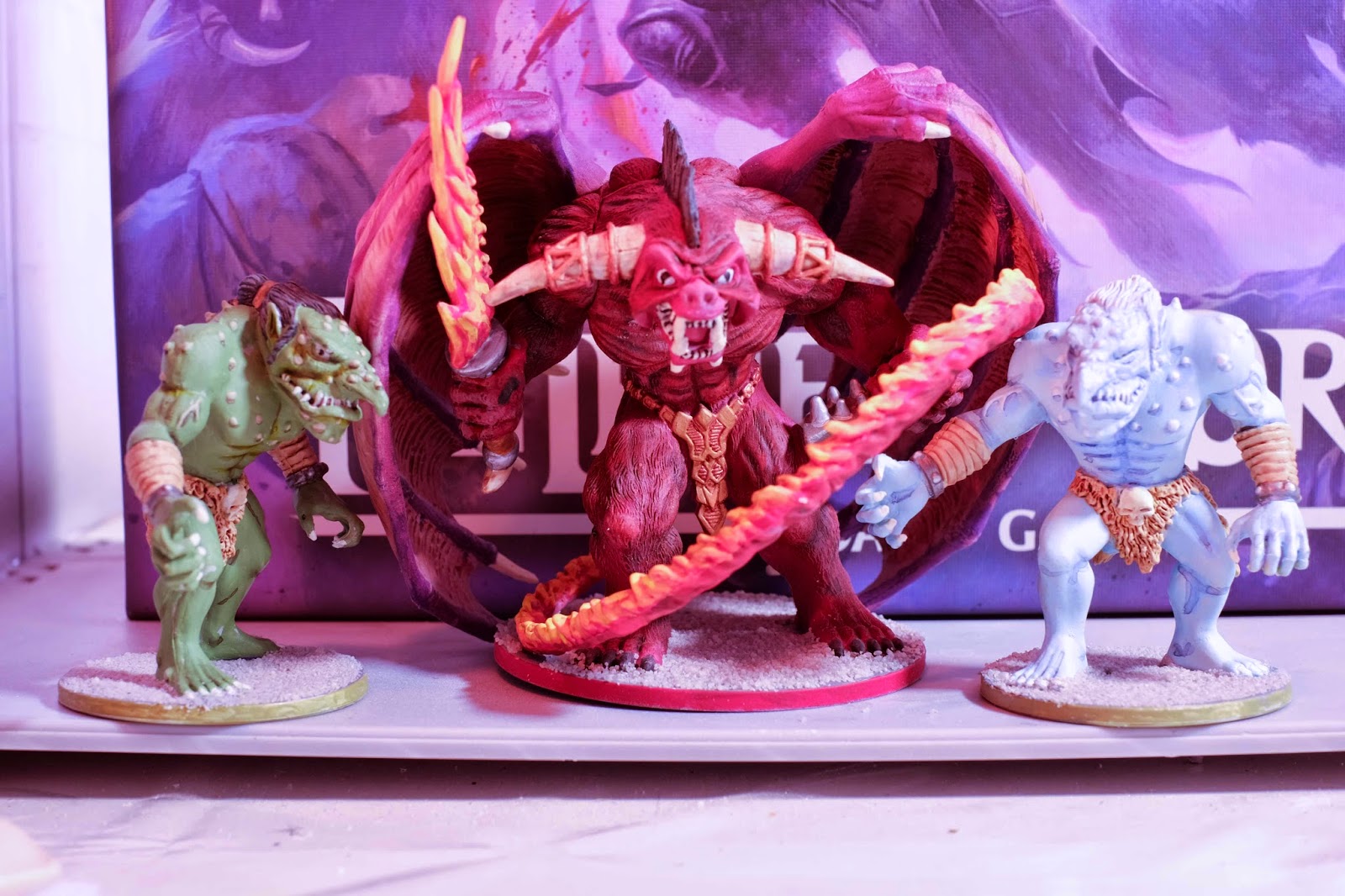
A troll, demon, and my alternate snow troll
The game includes a number of rather classic enemies, like goblins, demons and trolls. I decided to make one of the trolls into a snow troll to mix things up a bit.

Three drakes, the dragon Shimmergloom, and some sort of eye monster
Good ol goblins


Three other characters Jarlaxle another dark elf, a mind flayer, and Artemis Entriri

Of course with Drizzt there are also lots of his dark elf brethren for him to fight including a drider (half giant spider half dark elf).


Dark elves and spiders, including a dark elf wizard and priestess
A few of the minis (ghosts and water elementals) were in transparent blue plastic. I decided to keep the transparent look and used a few different coloured washes to shade them. I think the black washes on the mouths and eyes of the water elementals came out particularly nice. I’m not as happy with the ghosts but they look okay in person.

3 ghosts in blue, purple and green and three water elementals
One issue I wasn’t certain of was basing. I guessed that the game’s maps would be a mix of cavern style, stone tiles, and possibly snow and ice tiles (Drizzt lives in the north after all). So I kept the figures bases rather plain and painted them dark grey and just added some gravel for texture. The figures came in different coloured plastic, so I painted the lip of the base to match that original colour in case that affected some aspect of the game play.

So Jon this was for you. I’m sure you’ll enjoy trying the game out and reliving the adventures of one of your favourite characters. I also hope that in a few years these colourful figs might attract your two boys into trying the game out and that you can introduce these books and a love of reading to them. I’m so proud of all you have done and to call you a brother.

And for all the readers of Analogue Hobbies, Happy Holidays!

JeremyM.

Saturday, December 20, 2014

28mm Early Imperial Roman Officers


Here is my third entry to the Challenge. I'm planning a special scenario for the local group that is set during the Imperial Roman period and needed a few more Roman officer-types with whacky helmets.

These are a mix of 28mm castings from Wargames Foundry and Warlord Games. I believe they come from their Centurions and Optio packs but don't quote me on that.

The uniforms and kit are fairly fanciful, largely aligning to the Kirk Douglas and Charlton Heston school of ancient history. The reason for the absence of shield insignia on most of these models can be followed through the link above (which has a few more pics of these fellas) - it's all rather silly mainly due to the fact that I'm a complete muppet when it comes to working with decals.

Right now I'm working on my entry for next week's 'Rider(s) & Mount(s)' theme plus a few special entries for the holiday break. Now, to shoo away those odious carollers from the doorstep so I can get back to the desk...