Wednesday, November 9, 2011

Guest Post: Greg From The 'Peg - Getting Back To Work

Greetings to the readers and followers of Curt C's fabulous "Analogue Hobbies" blog. Since I am a fellow Napeleonic gaming enthusiast/nutcase, Curt has kindly invited me to provide a guest post as I get underway with my next major Napeolonic painting effort - more Austrians!

My 25/28mm Austrians have a good foundation, but to build up into a real fighting column, I will need more infantry - more line battalions - and some more guns. I already have two full German line battalions (and a solitary Hungarian one). I think six full battalions would make for a solid column - so the target is to get another four full line battalions finished in time for a planned game in late January.

The "big battalion" format we use calls for 40 troops per Austrian line unit. I like to mix a mounted officer in with each unit, so that calls for a total of four mounted officers, and 152 foot troops.

That's a big hill to paint, but I've painted a lot of these fellows in different scales, and the painting challenge sharpened this experience into a battle-tested, methodical approach.


For the first new unit, I dipped into my sizeable pile of Foundry castings and assembled another 39 models - one mounted officer, two foot officers, one musician, two colour bearers, and 34 "march attack" figures. For painting, I mount the models four to a "stick", or two infantry and one horse in the case of the mounted officer. For facing colour (this is a big deal for an Austrian painter), I opted to go with a regiment that had yellow facings.

I always do one "stick" of basic troopers to iron out any kinks. The second "stick" I paint always includes the mounted officer - getting the mounted fellow painted gives a good shot of momentum. From there, the unit expands pretty quickly - I started a couple of weeks ago, and I already have half the unit painted.


I find my approach to the white uniforms of the Austrians is on the darker/higher contrast end of the spectrum. I use black primer, whereas many others I have seen use grey or white primer. This is part subjective preference (it's just how I like them) and part belief that no white uniform worn in any kind of field situation really looks that white.

Anyway, my progression for the cloth involves black primer, GW Fortress Grey, GW Kommando Khaki, GW Bleached Bone, and the final highlight of Americana Acrylic White. The Americana paints are generally a little thinner, so I find it provides a nice final highlight. On the straps, I go straight from the GW Fortress Grey to Americana White.

Up close, the effect it a little jarring because it is not that subtle, but from arm's length, I really like it. It also helps the the multitude of straps pop out a little bit more on the troops.


I find horses to be a challenge to paint - I don't know why, but I often struggle with them. That's one of the reasons I like to get the mounted officer out of the way early.


The very last models I will paint prior to basing the unit are the musician and the colour party. Their uniforms are not all that different from the line infantry (what a nice contrast to painting the musicians for the bloody French!) but in my mind finishing the colour party last adds an internal sense of occaision as another unit prepares to take shape...

With these fellow well underway, I started to ponder which figures to go with next. I still have quite a pile of Foundry lead (most of it, thankfully, acquired several years ago), but now that Victrix finally has their plastic Austrians for sale, I thought I would give them a go!


A slight digression - I had grown so impatient waiting for Victrix to finally get these figures out for sale that I had finally sworn back in the summer that I would never bother with them, especially once news arrived that the Perry twins would release their own plastic Austrians. While I appreciated that Victrix was trying to get the plastic Napoleonics going, it was disheartening to see the Austrians wait (and wait, and wait) for releases like French Imperial Guard troops (sigh) or (much worse) 54mm stuff. It's one thing to be a flighty painter, but Miniature companies that can't focus make me insane.

For all that, once the figures were actually for sale, I decided to try them out (hey - I'm a figure junkie). Curt has some French and British units composed of Victrix models, and they are gorgeous. I was a little wary, based on what I had seen and heard, about all of the fiddly bits involved, but intrigued by the idea of doing a unit that had a little more variety in terms of poses, NCOs, etc. Foundry's Austrian collection is pretty comprehensive (or at least it used to be - the various poses seem to be disappearing), but it suffers from a monopose syndrome, and total lack of NCO figures.


I've done one "test stick" so far of the Victrix models. I have no direct exeprience building/painting British and French kits, but from what I can tell so far, Victrix has cut back on the number of fiddly bits for their Austrians. I still found them a little tricky to assemble, but you should consider that my lack of patience for model-building of any sort is absurdly high. This was not as bad as I had feared, so if it doesn't bother me, I'm sure a normal person will find the plastic Austrians to be very straight-forward to build. You get 56 models in a box - more than enough for a full battalion, and a good mix of options for different poses, without going blind putting the figures together. So far, so good - just had to see how they looked when painted.


Once again, a big decision when painting an Austrian infantry unit is what the facing colour will be - these fellows will have sky-blue facings. At some point in the future I will add second battalions of similar facing colours, but for now I'm taking the chance to expand the range of colour in the column.


I have to say the Victrix models are very impressive. I like the poses - a bit of a bend to show they've been doing a lot of marching, but the head still stoically forward. The detail on the models is very good - in some ways it exceeds the detail of the Foundry castings, especially the little shield on the cartridge box. The different options for the muskets give you plenty of choice without bogging you down in too many details.

The only weakness I have see so far is the detail in some of the faces, but overall, these are very impressive figures at a very good price.


In terms of mixing with Foundry in the same unit, I don't think that will neccessarily work - the Victrix castings are (in my opinion) noticeably taller and leaner than the Foundry castings. The thinner muskets and bayonets are also a clear difference. But having out on the table as their own unit will be just fine.


So that's my progress so far - out of 152 foot models and four mounted models, I've finished 22 foot models and one mounted model. There are a lot of good NHL and NFL games coming along, and I get lots of stuff painted when sports are on TV. Watch for more progress, coming soon!

Sunday, November 6, 2011

1er Regiment de Carabiniers (early uniform) Redux


The first group of these figures (ten I think) originated from my earlier days in the hobby and I decided last spring that I wanted to enlarge and rebase them so they better aligned with the look and feel of our 'Big Battalion' games. So here is the regiment, fresh with replacements, (24 strong) ready to be deployed on the tabletop.


The early Carabinier uniform is one of my favorites of the period as, to me, it personifies both the elegance and power of the French heavy cavalry at that time. Sure, the later brass cuirass and crested helmet was very fashionable and quite swish but I think it lacked the understated grace of the long-tailed cutaway coat, white waistcoat and tall bearskin bonnet.


It is believed that the regiment retained a high proportion of aristocrats from the ancien regime which may have helped it maintain a greater level of professionalism during that early period when the French cavalry typically suffered from a lack of experienced officers (at this time the guillotine was very busy providing 'advancement opportunities' to meritorious NCOs and junior officers). 


An interesting anecdote from this early period is during 1800, when the 1st Carabiniers were billeted in the small German town of Eichstadt. The impoverished town was so strained under the burden of French taxes that it faced the prospect of having to sell its sacred vessels from the local church in order to raise sufficient funds.  On hearing of this situation the Carabinier officers first tried to get the debt reduced, and failing that, passed the hat amongst themselves in order to pay the debt from their own pockets. For years afterward, long after the French were considered to be the arch enemies to all Germans, the grateful town of Eichstadt celebrated an annual mass for the 1er Regiment de Carabiniers a Cheval.


A little known but dramatic action involving the Carabiniers occurred early in the 1809 campaign when they faced against their equivalent in the Austrian Cuirassiers in a moonlit melee near the village of Alt Egolfsheim.  The Austrians were covering the retreat of their infantry after the Battle of Eckmuhl to which the French were vigorously pursuing. The Austrian Gottensheim Regiment of Cuirassiers led the charge and were met with a short range volley of carbine fire from the 1er Regiment de Carabiniers, who then slung their firearms, drew swords and charged. The combination of their numbers, training and superior mounts allowed the French  to prevail. (John Elting writes that the quality of the enormous Flemish and Norman horses was telling against the largely untrained remounts of the Austrian troopers)


The French heavy cavalry was used ruthlessly by Napoleon during the vicious battles of Aspern-Essling and Wagram. The cuirassiers and Carabiniers were often sacrificed to fill gaps or to buy time for the French infantry to recover and/or redeploy.


After the shocking losses they suffered during the 1809 campaign it was decided to equip the Carabiniers conforming with the regulations of the rest of the heavy cavalry arm, that is with helmets and full cuirass. With typical Gallic elan the Carabinier troopers received the news of them being issued armour rather poorly, thinking it to be an insult to their honour and courage and it took no small amount of convincing to have them surrender their beloved bearskins and long coats.


These are relatively older Foundry castings but they are still amongst the best depicting this early Carabinier uniform. I expect that either Victrix or the Perry's (if not both) will come out with a new rendition in the years to come.


Above is a small conversion to a cavalry casualty figure depicting a Carabinier trooper who has been shot from his horse which is gamely galloping forward with the charge.


As these larger cavalry units can be a bit of a nuisance to move around the table I decided to place them into movement trays that Sylvain kindly mocked-up for me in card. We decided to break them over two sections to facilitate both the extended line and supported line formations which were common doctrine at the time.


I think I have enough castings in 'the lead stocks' to do the 2nd Regiment but I'm afraid that'll be down the road as I need to get another Dragoon regiment done to fill out a proper brigade - but more on that later!


(Information from John Elting's Swords Around A Throne, David Johnson's Napoleon's Cavalry and its Leaders, James Arnold's Crisis on the Danube and Napoleon: His Life, His Wars, His World vol. 10. Illustration buy Angus McBride.)

Sunday, October 30, 2011

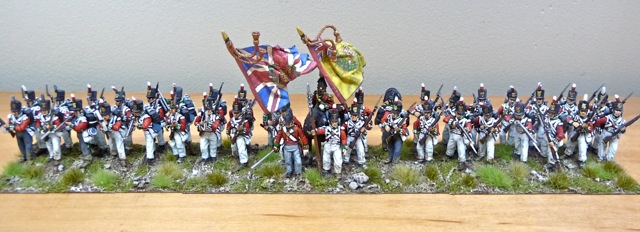
28mm British Napoleonic Battalion - The 2nd/66th (The Berkshires)


I've taken a break from my recent Steampunk silliness to base-up some new recruits for my British Napoleonic collection. This unit (composed of Perry plastics and a Victrix mounted officer) represents the 2nd battalion of the 66th Regiment of Foot (The Berkshires). I had mentioned previously that I was building a British force around Colborne's ill-fated brigade which was severely mauled by French cavalry at Albuera in 1811 (approximately 70% casualties throughout the brigade).


On top of being a speed bump for Polish lancers, the 66th had the distinct misfortune of loosing both its Regimental and King's colours that day.


The 2nd/66th was all but destroyed at Albuera. Of the approximately 400 men that made up the battalion at the start of the day, it suffered 16 officers and 310 men killed or wounded. The following day, it was able to muster only 53 bayonets. The majority of the casualties had been killed and among the dead were the battalion major, and the ensigns Walker and Colter. Captain Clark was taken prisoner, but was able to escape later, wrote that one of the flags was saved, but he does not specify which one. The remnants of the 2/66th was formed into a provisional battalion with the 2nd Battalion 31st, which had saved its flags. It was noted in its last inspection in Roncesvalles in 1813 said “The Battalion of the 66th doesn't have flags, because their new ones were sent to Lisbon in 1812. It is the undeniable test of their loss at Albuera, and the King's Colours also exists still in Paris”.


Another document, a letter from Lieutenant George Cromption of the 66th, dated May 18, 1811 states, "Oh, what a day that was. The worst of the story I have not related. Our Colours were taken. I told you before that two ensigns were shot under them; two Sergeants suffered the same fate. Lieutenant seized a musket to defend them, and was shot to the heart, what could be done against cavalry?"


These flags, in fact four complete and two reduced to the flagstaffs with their spearhead and  some fragments of their cloths, were sent by Soult to Paris, where they were temporarily deposited in the home of Marshal Berthier, until their presentation in the Tulleries in August 1811, along with 200 flags taken from the Spanish in the past campaigns.


After 1814, these trophies remained hidden until 5 April 1827, when five were displayed in the Museum of Artillery. During the Revolution of 1830, a mob stormed the Museum and took weapons and flags from it, including the King's Colour of the 66th Foot. 

In 1831, the four remaining Colours, were placed in the cornices of the chapel of the Hotel des Invalides. During the funeral of Marshal Sebastiani on 11 August 1851 a fire broke out. The Regimental Colour of the 66th Foot was completely destroyed, while the King’s Colour of the 48th Foot was badly damaged with only its central shield surviving. 

In 1861, General Duffourc d'Antist donated to the Invalides his collection of flags. Among these flags was the King's Colour of the 66th Foot which had been stolen by the mob in 1830.

From what I understand, currently there still exists the shield of the King’s Colour of the 48th Foot, which is in a frame in storage of the l'Armée Musée, while the King's Colours of the 66th Foot, as well as the remains of those of the 3rd and 48th are suspended of the cornices of the chapel of the Hotel des Invalides, which is part of the annex to the l'Armée Musée.

(Information from napoleon-series.org)

Tuesday, October 25, 2011

The First Martian Lift Wars - A 'Dystopian Wars' Campaign


Over the past few weeks I've mentioned the idea of running a small campaign to make use of my new collection of Dystopian Wars models.  Since I've always liked the Jules Vern / H.G Wells vision of space travel (being that ships can float through the 'aether' between worlds) I came up with the following premise:

The year is 1877 and scientists from Berlin's Reichsakademie fur Astronomie have been closely observing the celestial bodies, testing the theory that deposits of the valuable new element 'Sturginium' may be present and obtainable on nearby worlds.  Working from observations of Mars made by Giovanni Schiaparelli several German scientists believe they have discovered gas vents located in the north-west hemisphere of the Red Planet.


Giovanni Schiaparelli's original 1877 map of Mars.
The Prussian Empire was delighted in hearing this information, believing that they could mount an expedition to the Martian surface to claim any mineral rights before any of the other Great Powers were wise to the discovery. Unfortunately for the Prussians, their scientists, committed to the spirit of academic freedom and the sharing of knowledge, unilaterally decided to publish their findings in several international journals. When released their findings caused a sensation in the corridors of power.  As a result a race has begun between the four Great Powers to see who will claim the most Martian territory and establish rights of colonization and industry.


Our map depicting the north-west section of Schiaparelli's Mars.
Knowing that time is of the essence, each of the Great Powers has raced to assemble resources to send on an expedition.  The lift capacity of the newly invented aether cargo ships is prodigious, allowing them to 'lift' naval vessels through the Aetherium to Mars. As the Powers are all actively spying on each other during their preparations for the 'Lift to Mars' each nation has roughly matched the others in the composition of their fleets (fancy that!). They also realize that due to the distance of the journey, and the resources required, reinforcement will be very sporadic - essentially what each commander starts with at the outset will be his force entire, with very little hope of immediate resupply until they have exhibited some level of success (either by conquest or exploitation of resources). 

A mixed Prussian force advancing under fire.
Each strategic game turn on the campaign map represents one week. The speed of ships in the tactical game equate to a single hex of movement on the campaign map. For example, a frigate squadron which normally has a movement of 10" in the tactical game will be able to move 10 hexes on the campaign map over a week's time.

Japanese Cruisers steaming at flank speed.
Each nation has 100 'factors' of Marines to act as garrison troops for their land claims. Each nation also has 1000 'resource points' in which to build any installations and military infrastructure in which to aid their campaign.

Confederate Cruisers taking a pounding on their approach.
In our game the British have established their main base on Thyle, the Confederates on Phaetontis, the Prussians on Thaumasia Felix and the Japanese on Nivea. We're in Turn 3 of the campaign and we've already had a major fleet action fought between the Confederates and the British (fairly well-matched but the British did loose a Carrier). The diplomatic wires are ablaze with communication as everyone is jockeying for an advantage.

The doomed HMS Gigantic on fire and crippled...
Its all great fun as the players have really gotten into the spirit of their various roles. Its proven to be a good diversion as we say goodbye to autumn and head into winter. 

Sunday, October 23, 2011

Dystopian Wars - Confederate Fleet


In the Dystopian Wars 'universe' the American contingent is called the Federated States of America (FSA) but I thought that since we are dealing with alternate history it might be interesting to have a faction that was based around a sovereign Confederate nation, with the premise being that the Southern states had prevailed in 1863 and had won their independence. 
Three Perryville Class Frigates
So with this in mind I pondered on what are some quintessential 'Confederate' colours. Well, obviously grey would have to play an important part of the palette, but what else? When I was younger I did a lot of ACW re-enacting in the deep South (17th Mississippi) and really loved the uniforms of the Confederate officers, with their yellow facings and the gold braid ('chicken guts') against the grey wool. Finally, since the artillery arm often had red as their facing colour I thought that would be a good third accent for the turrets and gun positions.  So, here they are all in their 'Reb glory.

Sharpsburg Class Cruisers (with different generators in the central 'socket')
A Fredericksburg Class Battleship (with a rocket battery in the central socket)
2nd view of the Battleship with a Kinetic Drive installed.
A Chickamauga Class Aircraft Carrier.
2nd view of the Carrier with the fighters on deck.
A Gettysburg Class Dreadnought

A rather blury detail shot (sorry) of the Dreadnought.
Two Jim Beam Class Scout Airships


Two Mint Julip Class Heavy Bombers.
A squadron of White Lightning Fighters

Another pic of the Fleet.
This bunch was a lot of fun to paint up and, as you can probably tell, I had a good time dreaming up names for all the classes.  A few weeks ago I came up with a campaign game to involve the four fleets which we're playing now. Perhaps I'll put up a short post describing the campaign in a few days.