Showing posts with label 1:72 scale. Show all posts

Monday, March 2, 2015

Three Shermans, Three Rivers & Three Brothers


Since I'm slowly (oh, sooo slowly) collecting the forces that fought at the battle of Ortona I thought it best to include some of the Canadian Shermans who were tasked to support their fellow infantry in their assault on the town.  These were A and C Squadron's tanks from The Three Rivers Regiment (a regiment that originated from Trois-Rivieres a town between Montreal an Quebec City). One of extraordinary things I discovered while researching the battle was that there were three brothers who all served in A Squadron: Joe, Gord and Bill Turnbull (much of the following was taken from Zuehlke's excellent 'Ortona'). 

Gord and Joe both served as tank commanders, while Bill, the youngest, was a crewman in another Sherman.

At just eighteen, Bill had been to first to enlist in October 1940. Gord and Joe followed a few weeks later.  Joe, the eldest at twenty-five, had served in the Spanish Civil war in the Mackenzie-Papineau Battalion.  He had first tried to join the Royal Canadian Air Force but when the recruiters discovered about his past service in Spain, which was seen as an illegal act at best and smacked of Communism at worst, they had rejected him out of hand.  So a few weeks later he tried again, this time with the Army and conveniently neglected to bring up his fighting in Spain and as such was welcomed into the fold.

The three brothers were very devoted to one another and Joe in particular felt a great weight of responsibility to get his two younger brothers through the war alive.  This was quite a tall order especially with all of them serving in the same active tank squadron. In August 19143, in Sicily, eighty-four men in the regiment were killed or wounded and in one battle alone, with ten of the thirty tanks of their squadron being knocked out by enemy fire. 

After Sicily, the three Turnbull brothers participated in the heavy fighting along the Moro River and then were tasked to enter the vicious urban combat of Ortona.


A Three Rivers Sherman at a crossroads in Ortona. Note the commander spotting for the gunner and the ejector port open for the spent shell casings.
Joe wrote to his new wife, Peg, just before entering Ortona, explaining why he had become somewhat distant in his correspondence over the previous few months. ‘We are not fighting Italians now but the Germans, and they are in every sense equal to the toughest and finest soldiers in the world. They will not retire. They have to be killed. And there is only one way we can beat them, Peg, we have to be just a little bit tougher and that means we have to be put aside finer human feelings.’ 


Early in the battle Bill was wounded in the leg and evacuated. A few days later Joe had his tank knocked out in the tight confines of the town’s center.  After helping his crew to bail out of their Sherman Joe became separated from them and was forced to take refuge in a nearby cellar from raking machinegun fire. 


Ortona mural by Gerald Trottier
Joe’s brother, Gord, saw his older sibling’s tank get knocked out and then observed the escaping crew come under heavy fire. He quickly brought his main gun to bear on the machine gun position and silenced it.  Nonetheless, the resulting dust and debris obscured Gord’s vision so he could not spot his brother afterwards. 

It was not until the end of the battle, when Gord was searching the ruined town for his brother that he came upon him sitting in a shellhole, looking off into the distance, singing ‘Happy Birthday’ to himself (it was indeed his birthday).  Joe looked up and saw Gord, stopped singing, and the two brothers sat together for awhile in quiet companionship.

In the end, after serving through the rest of the Italian Campaign and then through North West Europe, the Three Rivers Regiment along with the three Turnbull brothers all returned safely home to Canada.


These three 1/72 scale plastic Shermans are from PSC.  Though I'm a bit of a muppet when it comes to doing-up vehicles, I found they were great little kits to work on. I built one as a ‘Firefly’ with its signature 17 pounder gun.  This in fact is a bit of cheat as ‘Fireflys’ were not issued in the Italian theatre until quite late in the war, but I've always liked the look of them and I thought I would indulge myself.

I like vehicles that look like they've been lived in, with lots of supplies, parts, etc. So I sourced the extra stowage bits (mostly resin with some white metal) from Milicast Models.  Fairly pricy but well worth it I think.   


When researching the Three Rivers Regiment I came across a great picture of one of their Shermans with a BSA bicycle strapped to the back of the tank.


I assume the crew thought it handy for scooting around when they were halted. I thought this quite neat and so sourced a bicycle from SHQ’s 20mm Volksturm range, trimmed off the base, added some new handlebars and positioned it atop the rear deck of one of the Shermans along with its other stowage.


I painted the trio in a basic British bronze khaki without the black 'Micky Mouse' camo pattern often seen in the Italian theatre. It is argued that the Regiment didn't use it at this time and in fact the vehicles may have been holdovers from the North African campaign.  I then heavily drybrushed and dappled them in dust tones as many of the pictures of Shermans at Ortona shows them as being completely filthy and begrimed from the rubble and clouds of dust.


The decals, as discrete as they are, are correct to the Regiment and are from Milicast as well.


So there you have it folks.  Three Shermans, from the Three Rivers, for three Brothers.


Thanks for visiting!

Tuesday, October 7, 2014

20mm WWII Canadian Infantry from AB Miniatures - The Battle for Ortona, 1943 (Part II)


This post is a continuation of one from a few weeks ago where I showed my first efforts depicting Canadian infantry during their 1943 assault on Ortona, Italy.

As with the original group, this squad is made up of ten 20mm figures from AB Miniatures, which can now be sourced through Eureka Miniatures. 

The Bren team along with the section leader who is armed with a Sten. Interestingly, from what I've gathered, the Canadians seemed to have loathed the Sten and usually swapped them out for Thompsons whenever they had the chance.

I can't recommend this range enough. I would, without hesitation, put them up against the best that 28mm has to offer. They have such wonderful, natural poses and their physiques are slim, almost gaunt, which from looking at contemporary photographs, seems to fit the period very well.

A rare colour print of a Canadian soldier in Med. summer uniform. Wonderfully lean and scruffy. They changed back to their heavier wool gear during December's Moro River campaign which culminated in the Battle for Ortona. 

The current marketplace for WWII gaming seems more or less dominated by either 15mm or 28mm miniatures. I find this interesting as it was only about ten or so years ago that 20mm figures were regarded as the uncontested scale-of-choice in this period. Frankly, to my way of thinking, the dominance of 20mm made perfect sense for wargaming (and still does) as there is an bewildering number of inexpensive plastic kits, die cast toys and railway stuff in 1:76 / 1:72  / 1:87 scale.


A case in point is this 'knocked out' Hetzer that I've included with this group of figures. This is an old 1:72 scale Esci kit (cheap as borscht) which I assembled and painted over an evening about 15 years ago. While a bit long in the tooth, I think it's aged relatively well (like it's owner ;)) and fits in perfectly with 20mm figures.


To me, 20mm is the ideal accommodation between the detail of 28mm and the sense of ground scale that 15mm affords. Don't get me wrong, I like every one of these scales and I collect WWII in all of them, including 6mm (yes, I'm a bit touched), but I have to say that I have a soft spot for 20mm. It gives the painter something large enough to work with, provides a nice sense of scale on the tabletop and it allows a gamer to amass a sizeable collection of miniatures and terrain without having to sell an organ to acquire and store the stuff.

The charming Italian building in the background is by Frederick C, a fellow Conscript from the Fawcett Ave gang.
In a week or so I'll post the last section from this platoon, along with it's HQ and some supports.

Next Up: Gladiators or Pulp Adventurers - not sure which yet...

Wednesday, September 24, 2014

20mm WWII Canadian Infantry from AB Miniatures - The Battle for Ortona, 1943 (Part I)


About a year ago I was rummaging around my storage shed and came across a collection of 20mm WWII figures that I had originally painted-up for use with Arty Conliffe's Crossfire (a very fine and innovative set of rules btw). This group of figures primarily composed of old, but quite good SHQ, Britannia and FAA models. This discovery began me thinking of how I could make use of these figures for future gaming. I decided that I could conscript my 15mm Flames of War collection (a set of rules I'm not especially fond of) for use with Crossfire and then I could use these venerable 20mm figures for skirmish gaming (Chain of Command, Bolt Action, etc). As I sorted through the lot I discovered that  I had scads of German Fallshirmjaegers (from a previous Crete scenario), but I needed some more Commonwealth figures to serve as opponents. 

So, I began snooping around the web and came across Anthony Barton's (of AB Miniatures) superb 20mm WWII range. So credit card was duly unsheathed and an order placed. Nonetheless, as these things frequently go, by the time the figures arrived I had abstractedly wandered off to another project (I know, how typical) so the castings were studiously unpacked, briefly admired and then stored away awaiting further inspiration.

Canadian armour moving through Ortona by Charles Comfort
The spark came a few weeks ago when I began reading about the 1943 battle of Ortona which occurred during the Italian campaign. In the larger scheme of things this battle was largely a sideshow, dwarfed by the campaigns in the Eastern Front and overshadowed by the impending landings in Normandy, but to many in Canada Ortona is regarded as our own 'little Stalingrad' due to its brutal and unrelenting house-to-house combat.

'Reinforcements Moving up in the Ortona Salient' by Lawren Philips Harris
As a brief background, Ortona is a port town situated on the Adriatic coast of Italy, relatively close to Rome along a east-west axis. In 1943, with the Allies lines of supply stretched to the extreme, Ortona was regarded as strategically important as it possessed one of the few ports which could accommodate deep-draught shipping. 


For this reason Montgomery wanted it taken and so General Christopher Vokes, commander of the Canadian 1st Infantry Division, ordered his men to batter their way into the town through a series costly frontal assaults along its approaches. Vokes wasn't necessarily a bad commander, but he really wasn't very good either. Monty regarded him as 'a plain cook' and I think that assessment is fairly accurate. So instead of bypassing the town and threatening to pocket the Fallshirmjaegers garrisoning it, Vokes decided to take Ortona by direct assault. 

Map of Ortona showing the path of the Canadian assaults.
The Germans had positioned themselves very well, establishing interlinking fields of fire for effective ambushes, and had littered the advance with mines and boobytraps. The Canadians found that attacking over the rubble-heaped streets while under enemy fire was extremely gruelling and so the casualty toll rose.  The Canadians realized that they had to develop other means in order to grind ahead or the attack would stall completely. One notable trick they came up with was the tactic of 'mouse-holing' (also used in the fighting at Stalingrad). This involved the Canadians blowing a hole through the adjoining walls between upper floors and then systematically working their way down. While this tactic was effective in keeping the men out of the fire-swept streets, the process was fraught with danger as the advance from room-to-room often involved ferocious close-quarters combat.


Over eight days, from December 20th to the 28th, the Canadians of the 2nd Brigade forced the German paratroopers out of the town, but at a cost of nearly 2400 in dead and wounded. The Moro River campaign (of which Ortona was a part) inflicted almost a quarter of all casualties suffered by the Canadians during the entire Italian campaign. After reading the accounts of the campaign one can appreciate why the term 'D-Day Dodgers' deeply rankled with the men fighting up the Italian peninsula.


I painted these figures to represent men from the Loyal Edmonton Regiment and the Saskatoon Light Infantry which were two of the four infantry battalions which were committed to the battle (the other two units were the Seaforth Highlanders and the Princess Patricia Canadian Light Infantry). 


I was struck by the photos of the incredible amount of pale/white rubble in Ortona so I tried to replicate the same in my groundwork, with lots of shattered masonry, dust and debris scattered about.


I've pretty much completed a full platoon, with various supports, but I thought I'd show them over two or three blog posts so the sculpts can stand on their own and not be lost within a mass of figures. 


These castings were a real pleasure to work on and I hope you enjoyed looking them over. 

Next: To mix things up, some Post Apocalyptic Raiders!

Monday, March 10, 2014

From BenG: 20mm Napoleonic British 12th Light Dragoons (64 points)


From Ben:
I managed to get these finished before the deadline and boost my score, so these are definitely a bonus!

These are actually part of Strelets' Egyptian Campaign range, but they'll be doing service in my British Peninsular War army. The only thing which indicates the earlier period is the queues which the riders sport, but as they are the only Tarleton equipped British light dragoons in 1/72nd, they'll do until HaT get their act together and finally release their British cavalry for their Peninsular range.
Strelets figures are rather chunky, but fit in well with the earlier HaT range like their 8095 French infantry. Even the horses are chunky, looking more like Welsh pit-ponies rather than English thoroughbreds! The figures are rather characterful with expressive faces and dynamic poses.
I was always reluctant to invest in Strelets figures as they look so ugly unpainted, but rather surprisingly, look great painted up!
You're right Ben, they look very good indeed - you've done a wonderful job on them.  The poses on these figures are very dynamic. I quite like posing of the two fellows slashing with their sabers. It makes me cringe to think of the poor infantry who are the subject of their not-so-tender attentions.

These eight troopers of the 12th will give Ben 64 points. It's wonderful to see you building some distance from your initial Challenge goal - well done!

Sunday, March 9, 2014

From SeanS: 20mm Hundred Years War Archers (80 points)


From Sean:
These 20 1/72 scale plastic figures are meant to represent a portion of the army of Treyine in the Talomir Tales campaign. Treyine is supposedly 100 years war England in flavor. This bunch comes from Zvezda English Infantry of the 100 Years War, Zvezda Medieval Peasant Army, Airfix Robin Hood and Strelets Military Order Warriors for the two footmen.
I have been futzing around with these figures for what seems like months. I have to say that painting the 28mm figures feels like a breeze compared to these. I cut out the final dry brush over the ink wash as I didn't feel it was going to add anything. I also experimented with both Burnt Umber and Sepia washes and I like the variety. The varnish step was a little more problematic and a couple of the figures came out ultra shiney. I was able to knock that down with some Vallejo Matte Varnish, excellent stuff. I will do a post on my blog with comparison shots when the figures are released to be put up there.

I hope you all enjoy my very first non themed entry. I'm hoping it will not be my last.
Lovely work Sean. I really like the varied poses of these figures, especially the fellows who are in the midst of nocking and drawing their longbows. I also like the muted effect you achieved with the two washes, it really reinforces the grubby nature of the period. 

This gaggle of archers will give Sean 80 points. Great job!

Thursday, March 6, 2014

From KevH: 20mm Anglo-Saxons Thegns & Saracen City Militia and Ghazi Fanatics (182 points)


From Kev:
Sculpting's done for now so I am back at the painting table, yaaay. First up are an addition to my 1/72 Dark age collection.
The Anglo Saxon Army in "Hail Caesar" is allowed a single small unit of Mounted Thegns. I could have chose the easy route for these and just painted 4 of the Revell ones. But no, thats not me and I do prefer the Strelets. So here we go, Strelets and Revell conversions. A few head swaps and the odd body swap and all on Strelets horses. 4 mounted Thegns to give the Anglo Saxons a bit of fast hitting power.
Then back onto the Crusades. More infantry for now. First up are another City Militia unit. 12 Figures, these are 3 to a base to show they are a Medium infantry unit.


Then closely followed by the first of the Ghazi Fanatics units. This is a warband, (24 figures) hence the double ranks.
Once again a medium infantry unit with 3 to a base to show this. I decided on a uniform colour scheme for the Fanatics as I wanted them to look menacing on the table. Andy had the idea for the red headgear. Red, black with a bit of white give these the look I wanted and will easily make them recognisable on the table.
The other fanatic units will be a slight variation on this scheme.
All the Saracen figures are HaT 1/72 and from their ElCid range and painted in my high contrast style. I am now working on some of the Saracen Cavalry, at last, lol.

Beautiful work once again Kev! I particularly like the unit of Ghazi fanatics - those colours certainly reinforce their intended role. 

These fellows with their excellent banners, shields and conversions will give Kev 182 points, allowing him to wrest back control of 2nd place from Dave. Nonetheless with only a 48 point spread between the two it's really anybody's race. Pretty exciting stuff!

Saturday, March 1, 2014

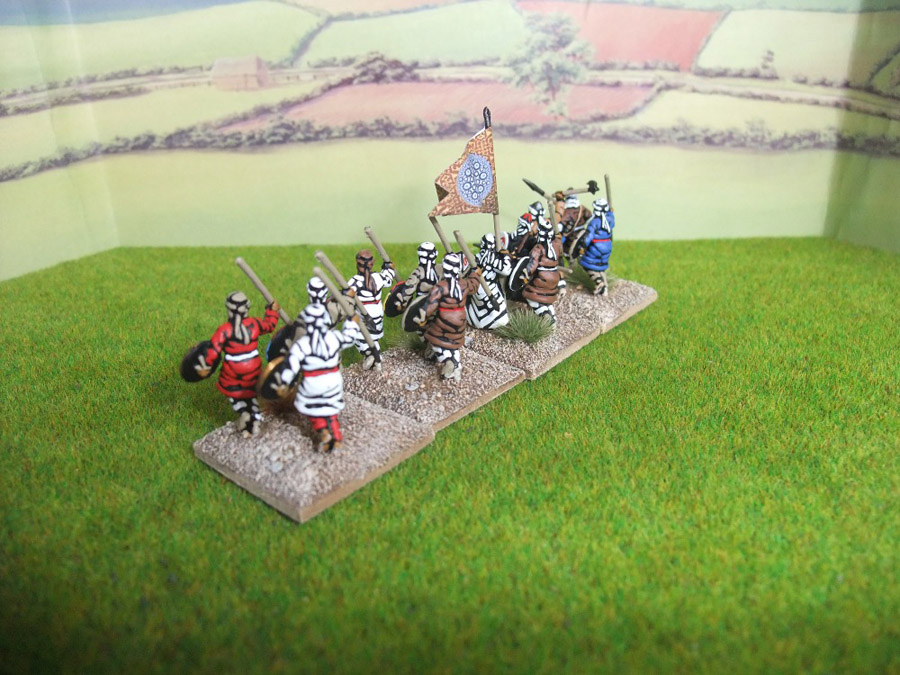
From BenG: 20mm Roman and Goth Infantry (68 points)


From Ben:
Well, I'm back at work after having all January off and my hobby time is somewhat limited these days! 
These will probably be my last entries unless I can get the British Light Dragoons, which I've been slowly working on, finished in time. 
The Romans are by Miniart with a couple sporting head replacements from the Italeri set. You can probably tell the conversions as they're the ones whose facial features you can actually see!

The Goths are from the Strelets ancient German set.

One more stand of Goths, and I'll be able to pit the two sides against each other to see how the rules handle, then I'll just have to do a couple more skirmish and cavalry stands and I'll be ready to host a proper table-top stoush late antiquity-style!
Excellent work Ben! I'm anxious to see the two forces meet and the rules to be blooded. Please send along a note and a pic when this great event hits the tabletop.

These Romans and Goths will give Ben 68 points which includes a bit extra for the conversions, tartans and shields. This will give him enough to exceed his Challenge target of 600 points. Congratulations Ben and well done!