Showing posts with label Spanish Civil War. Show all posts

Wednesday, January 12, 2022

Spanish Refugees from Malaga & Dr. Norman Bethune, 1937


Hi All,

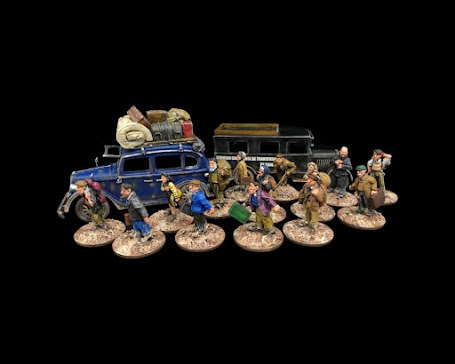
Today I return to my Spanish Civil War project with this group of civilian refugees. 

Sarah and I have been fortunate enough to visit both Cebere France and Malaga Spain in previous vacations. Both of these communities are set in beautiful locations, nestled along the Mediterranean coast, but both share a dark history in that they were also sites to horrible events during the Spanish Civil War. I've written about Cebere before, but I've been wanting to do something specific for Malaga for a while now.

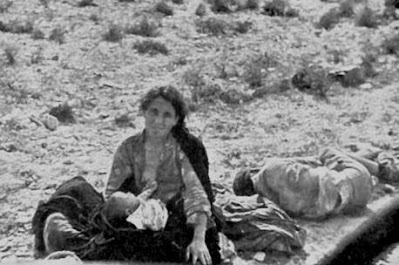
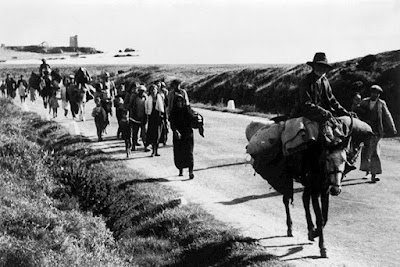
In February 1937, the Mediterranean port town of Malaga found itself threatened by the rapid advance of Nationalist forces. In a state of panic, 120-150,000 people, composed of men, women and children, fled along the coastal road leading to Almeria, 200 kilometers away. In an act of barbaric cruelty, the Nationalists and their Italian allies harried the refugee column for days, submitting it to both air attacks and off-shore bombardment.  Thousands were killed and wounded during the flight, in what many regard as a war crime exceeding that of the infamous bombing of Guernica. 
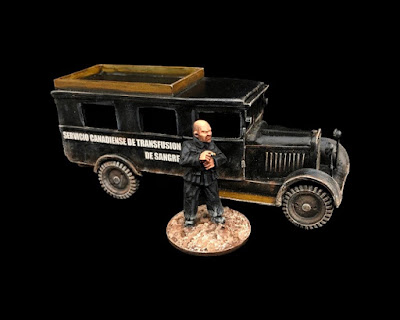
At this time, a volunteer Canadian surgeon, by the name of Norman Bethune, was working in the area with is independent blood transfusion ambulance. 
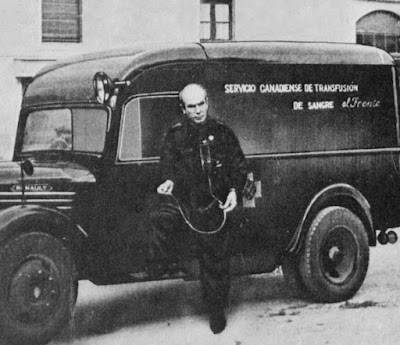
Hearing what was occurring along the coastal road, Bethune and his team quickly drove to the stricken column to give what assistance he could.  For three days and three nights Bethune and his assistants helped evacuate some of the most vulnerable to Almeria, and then provided medical care to the most grievously wounded.

In 2007, the city of Malaga officially honoured Bethune's heroic and humanitarian acts with a commemorative plaque and by naming that portion of the Malaga-Almeria road, Paseo de los Canadienses (The Canadian Promenade). In order to visit the plaque and pay our respects, Sarah and I spent a nice afternoon cycling up to the promenade, situated just a few kilometers outside of Malaga.
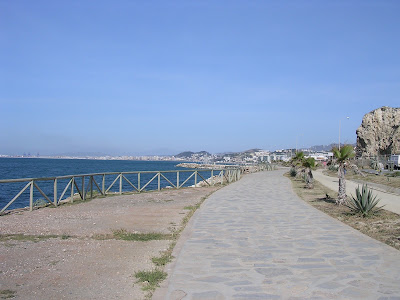
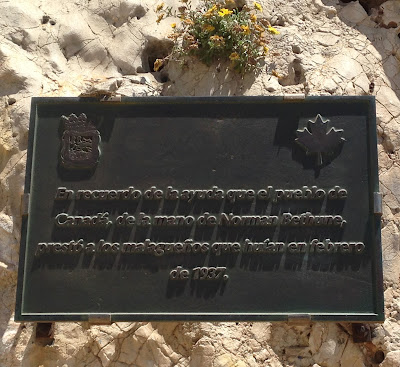
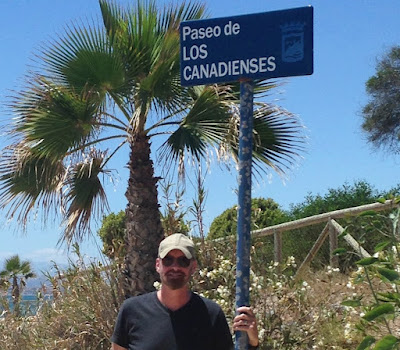
A fine way to spend a wonderful day in sunny Spain.

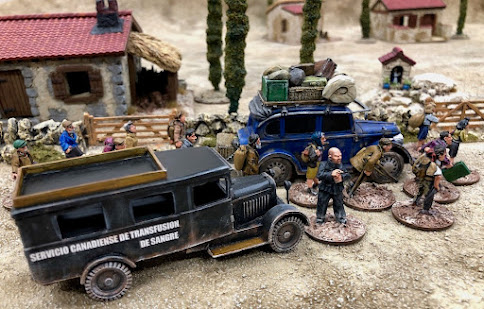
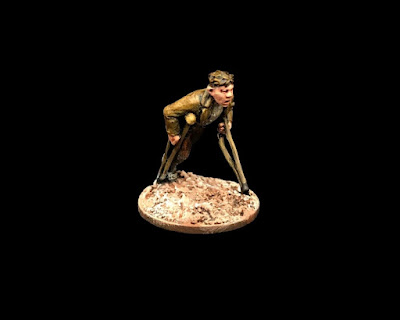
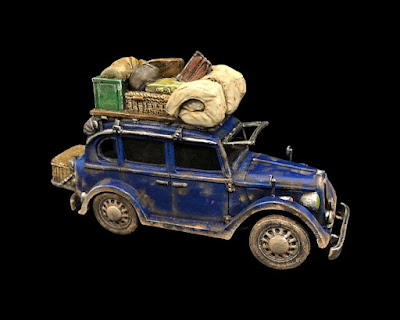
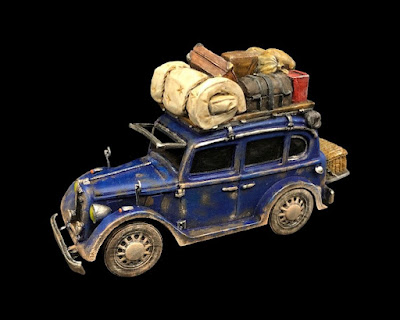
Accordingly, I've done up these figures and vehicles in homage to those events in Malaga. The saloon car and most of the figures are from 1st Corps, the Phenom Granit ambulance is from Empress Miniatures and the poor fellow with the crutches is from Eureka Miniatures. 

My only criticism of the 1st Corps range is that there are not many elderly people, nor any children depicted. I know it's tragic, but I think it is something that should be represented if depicting a refugee column. Maybe they will add some in future releases.
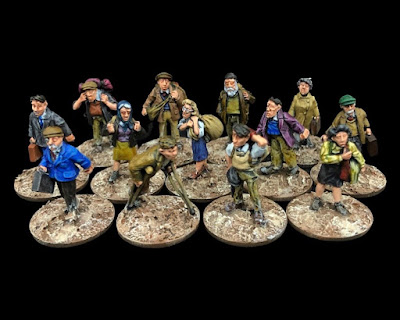
Small quibbles aside, I quite like the 1st Corps figures as they are well-sculpted and very characterful. Even more so is this wounded chap on crutches from Empress Miniatures - a brilliant mini.  
The two vehicles were fun to work on, especially the saloon, with its roof haphazardly overloaded with all manner of assorted household items. You really get a sense of a harried family who have just thrown what they could atop their car and pushed off down the road.
I had to get a bit creative in sourcing something for Dr. Bethune. I ended up using a German officer figure from Artizan which I cut away most of his military detail and modeled some baggy civilian trousers out of greenstuff. Granted, it's a bit crude, but I think it does an okay job at mimicking the good doctor.


Another 'one yard squint' is the ambulance. It's definitely not a close match to Bethune's vehicle, but has the benefit of generally having the right silhouette. 

I really wanted to include the identifying Spanish script on the vehicle's side panel, but my decal-making skills are sorely lacking, so I simply colour printed  what I needed, carefully cut it out, and glued it into place. Again, forgive me in my somewhat clumsy homage. 
Thanks for dropping in and have a great day everyone!

- Curt


Thursday, August 22, 2019

Worst Case Scenario #19: SCW Rearguard during 'la Retirada' ('The Retreat') - Northern Spain, February 1939


This past spring we spent a few wonderful weeks vacationing in the south of France in the Roussillon area.  

This region is ruggedly beautiful and steeped in history extending back to the ancient period. Roman ruins, medieval castles, an excellent privately run Napoleonic museum, you name it - it's all there to take in and enjoy. In addition to all this, I managed to find the gravesite and pay my respects to one of my favourite authors, Patrick O'Brian (creator of the superb Aubrey-Maturin series of novels). He rests with his wife Mary outside the beautiful seaside village of Collioure, where they lived in their later life.


One of the other border towns we stayed in was Cerbere, which is situated along the Mediterranean, right alongside the Spanish frontier. Interestingly enough, Cerbere was one of the major crossing points for Spanish refugees who fled from Franco's final offensive in early 1939. 


A bit of background. The Spanish call this period 'la Retirada', The Retreat. At the time it was one of the largest refugee crisis in Europe, with almost a half million people fleeing into France during January and February, 1939. It quickly became a humanitarian crisis as the harsh weather along with the poor conditions of the refugee camps caused many to die of undernourishment, disease and exposure.


Some of the refugees, spurred by the terrible camp conditions, accepted deportation back to Spain. Unfortunately, they suffered oppression, discrimination and often execution by Franco's vitriolic fascists. Others were lucky enough to be accepted as exiles in the Americas and other parts of the world, but many chose to remain in France. Those who stayed had to endure a new war against fascism, some tragically being transferred to German concentration camps, while others fought with French Resistance cells and the Free French Army under de Gaulle. 

Over time, the Spanish refugees that remained in France were assimilated into local Occitanie communities, adding to the rich and diverse culture found in that region today.


The site commemorating 'la Retirada'  at the border crossing between France and Spain near Cerbere .


Me at the la Retirada memorial.

____________________________________________


This visit (and subsequent research) prompted me to put together a small 'Chain of Command: Espana' scenario for the guys. 

The Scenario

The scenario is a simple affair,  depicting a cobbled together Republican rearguard attempting to buy precious time for their refugees to make it to the frontier unmolested. 

Peter commanded the Republicans, which were composed of a platoon-strength smattering of anarchists and militia, salted with a few regulars and assault guards from the shattered Republican army. Not surprisingly, they have no heavy equipment, with only a couple light machine guns to bolster their firepower. Nonetheless, one huge benefit they do have is that they are all fanatical volunteers, making them damnably hard to break. 

Stacy and Jeremy ran the Spanish Nationalists. This force is mostly comprised of ardent-though-brittle Falagists, stiffened with a squad of Morroccan Regulares and a some Carlists. Perhaps more importantly, they have access to an armoured car along with artillery support from their navy posted just off-shore. Yes, an overwhelming force, but it needs to be brought to bear in a very short period of time.

This leads us to the victory conditions: The Republicans have to hold back the Nationalists for six turns, by which time they have purchased enough breathing space for the retreating refugee columns to reach the frontier. 

In order to mimic the steep terrain of the region, I propped up the play surface on a row of stacked books. This is a nod to Simon over at BigRedBat who used this to great effect for his Battle of Mancetter, 61 CE game at Salute this past spring. Thanks for the inspiration, Simon for this simple but effective hobby hack.


The Planning

The Nationalist players, knowing that they had a distinct superiority in firepower, planned to set up several firing positions hoping to simply destroy the Republicans under sheer weight of firepower. 

Peter in turn, felt it would be unwise to risk any close assaults over open ground and instead decided to keep his forces' heads down, exploit any Nationalist mistakes and play for time.


Looking left down the hillside from the Republican held crest.
...and looking down from the right.


The scenario essentially played-out along these lines. The Nationalists kept up a constant tempo of fire, whittling down the Republicans every turn, whereas the Republicans kept close to their cover and returned fire when they could. It was all very attritional for both sides, with many fingernails being chewed as the casualties mounted and the clock worked its way to the game's conclusion. 


Above, units from the Nationalist left wing attempt to move forward into assault range. They are ultimately pinned down from accurate Republican rifle and LMG fire.

Republicans taking shelter in a shellhole while trying to hold their right flank.
The fearsome Moroccan Regulares advancing under fire to establish future assault position.
Carlists move alongside the Moroccans trying to try to press the Republicans.


A fascist armoured car slowly makes its way up the treacherous switch-back road to add its fire upon the Republican positions.


The Nationalist HQ finally got their field phone set up and, after a few turns, started to bring down artillery fire from their naval assets positioned off shore.


The Nationalist navy guns find their range and begin to pound the Republican positions - ouch!

A remnant of a shattered Republican squad taking shelter in a stream bed.
In the end the Republicans managed to weather the Nationalist firepower and hold on until nightfall, forcing the Nationalists to call off their attack for the day. This allowed the refugees a few more hours to seek safety at the French frontier. A pyrrhic Republican victory, for sure, but somehow fitting for the period.

And here is Earnest and George, giving a cameo appearance for the close of the scenario (Thanks Phil!)

Next up: A few of the projects I've been (slowly) working on over this summer.


Wednesday, August 30, 2017

Spanish Civil War Figures for Nick and Christopher


During our last Painting Challenge I had a fun brush duel with Nick, Christopher and Phil to see who could paint the most points of Spanish Civil War figures. I really thought I had it in the bag by establishing an early lead, but Nick took the prize in the last few weeks with a tremendous entry which, try as I might, I couldn't manage an effective riposte. Well done Nick!

So, here I present my tribute figure to Nick for his well-fought win: a Republican dinamiteros preparing to throw his pipebomb IED. 


This figure is from the excellent Empress range. 


I'm also sending along a LMG team as a belated reply to our Annual Friendly Figure Swap.


These guys are from Wargames Foundry's French partisan range which I think work very nicely for Republicans. If you squint a little, the Bren becomes a period appropriate Czech ZB vz 26. :)


AND for Chris, a Canadian standard bearer from the 15th International Brigade for being such a great supporter of the Challenge all these years.


Again, another Empress figure. He's carrying the Mackenzie-Papineau Battalion colours


I'll be following up with a figure for Phil in a few weeks. That one I plan to hand-deliver later this autumn when we visit Crisis in Antwerp (SO excited). Now, how's that for service!

Next Up: An AAR from our '43 Italian campaign

Monday, March 27, 2017

Spanish Civil War Moroccan Regulares Command Team


Here is the first in series of small posts from me this week. 

This time it's a quartet of Moroccan Regulares: an NCO, a rifleman, their officer and his banner bearer. 

These 28mm castings are from the excellent Empress Miniatures SCW range, sculpted by the talented (and astonishingly prolific) Paul Hicks. 


For ease of identification on the tabletop, I use hex bases for officers, squares for NCOs and rounds for the foot-sloggers.


These four will join the rest of my hard-bitten veterans in the display cabinet.


Thanks for visiting folks!

Thursday, January 19, 2017

Spanish Civil War Miliciana Standard Bearer and AAC-1937 Armoured Car - 5th Submission to AHPC VII


I know I had promised an Indochina post, but these two practically leaped onto the table demanding brush and paint, so here they are.

This past summer saw the 80th anniversary of the outbreak of the Spanish Civil War, and this autumn marked when Republican Madrid held fast against Franco's Nationalist forces. 

A significant amount of credit for the city's resistance was due to the arrival of reinforcements from Barcelona, led by the charismatic anarchist Jose Durruti. His force, known as the 'Durutti Column' became famous for its assistance in fending off Franco's hardened Moroccan professionals. The anarchists took particularly heavy casualties, including Durruti himself, fighting in the Casa de Campo (Madrid's largest park).


Durruti, in car crudely marked with 'C.N.T.', with his column heading west in the autumn of 1936.


Durruti's ad hoc column of Republican fighters on the move.

Durruti's death is still shrouded in controversy. Some say he was killed by enemy fire, while others contend he was a victim of friendly fire.  A few go so far as to say he was killed by Soviet-led Communists who saw him as a threat to their leadership within the Republican cause.

So, seen here is a miliciana standard bearer, wearing the distinctive blue workers overalls (el mono azul), giving the Republican clenched-fist salute and holding aloft an anarchist flag. The flag is emblazoned with 'Columna Durruti' and the acronyms of the two largest anarchist workers militias, the C.N.T and the F.A.I.

The figure is from the Empress Miniatures' range and the banner is from Flags of War.


Behind her is a AAC-1937 Chevrolet armoured car. This vehicle is often mistaken for a Soviet BA-3/6, but in fact was built in Valencia, using a Chevy 6x4 chassis as a basis. This one is armed with a hull machine gun along with a 37mm gun with a coaxial MG. It saw service in the later part of the civil war.


Many of these vehicles were captured by the Nationalists, or confiscated by the French during the Republicans' final retreat into exile. Oddly enough, many would see the end of their active service as German armoured cars on the Eastern Front.


This vehicle is, again, from Empress Miniatures. A nice, simple and clean kit. I've given it a fairly basic paint job in dark olive green, which seemed to be a relatively common colour  for vehicles at the time. It has 'U.H.P.' on the upper hull, denoting it's crew as supporters of the Uníos Hermanos Proletarios (United Brothers of the Proletariat) a socialist workers organization, part of the alphabet soup of socialist-anarcho-sydicalist trade unions that were (and still are) popular in and around Barcelona. 


Next up: Indochine (no really, it is, I promise)