Friday, October 12, 2012

Spanish Anarchist 'Milicianas': Women in Combat During the Spanish Civil War


Having just finished Antony Beevor's excellent 'The Battle for Spain', and while still working through the very characterful 'A World Aflame' rules from Osprey, I thought I'd paint up some more SCW figures to add to the collection.


In reflecting on Beevor's book I was particularly struck by the important role that women played in the conflict. Many women of Republican Spain took up arms and fought as milicianas on the front lines alongside their male counterparts. This is particularly extraordinary as Spanish culture at the time was very conservative in it's view to women's roles both at home and in their communities. The surge in new political ideologies such as socialism, communism and anarchism, and the subsequent outbreak of civil war all acted as a catalyst to release many women from their previously restrictive positions in Spanish society.
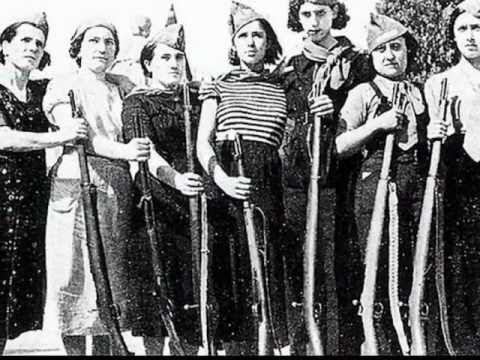


What makes this especially remarkable is that these milicianas did not have any real intellectual template or framework of what a 'women's movement' was, or specifically what feminism meant. Literacy amongst women in Spain was relatively low, and even if all Spanish women could read there was very few books on feminism available in their language. Instead these women fought for a very pragmatic desire to secure down-to-earth yet fundamental changes to their position within Spanish society.


As such the women that fought for Republican Spain took risks that were often far greater than their male counterparts. They knew the fate which awaited them if they were captured by the Nationalists, especially if they were composed of North African troops (there are several instances where milicianas took their own lives rather than be captured). So with the stakes so high, their courage was often very inspirational to their male comrades.


A Scottish volunteer, Tom Clarke, related an incident that occurred during the Battle of Jarama in January 1937:
I remember there was a bit of a retreat. There was a rumour that went around, I can't remember what it was, and we started retreating. We'd gone back a bit, and some of (us) were actually running. And here we came across three women sitting behind a machine gun just past where we were, Spanish women. I saw them looking at us. You know, I don't know if it shamed us or what. But these women stayed there. 
I found this to be an evocative mental image and wanted to create some sort of vignette to try to reflect it. This was actually made pretty straightforward thanks to the excellent range of female Militia figures offered by Empress Miniatures,  with one pack featuring a wonderfully sculpted machine gun team who are crewing a Czech ZB-30 LMG (the precursor to the British Bren).


I wanted to give the impression that the LMG team was deployed in a more urban setting. So, inspired by photos of the city fighting of the period, I cut up some balsa rod to make bricks and boxes, in order to mock up an ad hoc barricade.


The third figure in the LMG group is a kneeling woman firing a revolver. To me this figure seems to be directly inspired by a photo taken by Gerda Taro (photographer and then lover of Robert Capa) of a female 'miliciana' near Madrid.


The figure firing the pistol has a very close resemblance to Taro's photo - very cool.


For a uniform colour, I decided to mainly go with variations of blue which was common with workers' overalls (often called a 'mono') worn by militia units in cities such as Barcelona and Madrid. Several of the figures are wearing red and black side caps and scarves, which indicates them as being part of one of the anarchist workers militias under the FAI (Federacion Anarquista Iberica) and/or CNT (Confederacion Nacional del Trabajo).


Male FAI Group Leader

In time I'll probably add a few more figures to this group to take it up to a full squad. 

Next for this period will be the utra-conservative Catholic monarchist fighters, the Carlist Requetes.

I'll end my post with this very striking photo taken by Juan Guzman of Maria Jinesta, 17, a miliciana in her home city of Barcelona. The photo was shot in the summer of 1936, just a few days into the conflict. I look at her face, which is so full of optimism and pride, and am curious to know of her fate in the following months and years. It would be nice to think that she survived the Civil War and perhaps achieved some of the dreams and aspirations she bravely wished to defend.

Maria Jinesta at the Colen Hotel in Barcelona. Photo by Juan Guzman, 1936. 

Monday, October 8, 2012

Wargaming Against the Weather: Outdoor Naval Wargaming

'Sorry Curt, I can't really hear you from the howling wind and my pulled-down touque. Did you say something about someone looking like a dork?'
Sylvain again here. (With unwarranted photos and editorial comments from Curt.)

Not long ago, I presented some newly painted 1:1200 ships on this blog, along with some crazy plans to play outside. I came up with an hypothetical scenario: 

7 December 1941 - Because their crews were involved in a bar fight the week before, the Admiral decided to send at sea the USS Colorado and the USS Arizona, for a gunnery practice involving lots of healthy drilling. However, after a day at sea, the two battleships stumbled upon two Japanese battleships, part of the Japanese Fleet sent to attack Pearl Harbour.

AMERICANS: USS Colorado, USS Arizona
With their slower units, the Americans know they are in trouble. The American player's objective is to inflict damage to both Japanese ships in order to slow them down and then try to escape in order to participate in the defense of Pearl Harbour.


JAPANESE: IJN Ise, IJN Kongo
Banzai! The goal of operation Tora Tora Tora is to eliminate as many American capital ships as possible. The Japanese player wins by sinking at least one American ship and then escaping.


All the models are from Superior Models.

After a week of being harassed, Curt and Peter kindly agreed to give the game a try. The weather was as to be expected for the season, but a little challenging for wargaming: cloudy, about +8C, very (VERY) windy.

Peter: 'Right, and who's idea was this again?'
Admiral Peter, of the US Navy, in command of the USS Colorado and the USS Arizona, about to spot the Japanese intruders.You can read his report of the game here.

Curt: 'F*ck, its cold! This is not the South Pacific, its the bloody Murmansk Run!'
Kaigun Taisho "Kaato" (Japanese pronunciation of Curt), maneuvering the IJN Kongo toward Pearl Harbour. He is holding a turning gage, formerly known as a paper plate.


This picture gives a sense of the firing distances. Ships were firing at 20', and they were about 40' apart. Hits happened at about 30', which is about 12,000 yards. "Real" naval engagement, according to what I have read, would take place at about 18,000 yards (45' at this scale).

Sylvain cutting quite the dash in his wargaming toolbelt - Ooh, TRES sexy!

Peter rangefinding with his... iPhone... obviously the Americans have a leg-up in gunnery technology.
Shells from the Colorado are getting dangerously close to the Kongo. Captain Peter proved to be very effective at guessing range. On the following turn, the Colorado scored a hit on the Kongo while the Ise hit the Colorado in return. Both ships lost a main turret.


Kongo's fire ranging in on one of the American battlewagons.
A hit! A palpable hit!

Peter running madly after a turn gauge being blown away in the wind. I'm sure there's a song somewhere in there...
Sylvain is having waaay too much fun with his monster tape measure.
Curt's Kongo getting 'bracketed' by American fire. Ouch!
Bullseye! Guessing the exact range, directly onto a a ship's base translates in 2 hits. The Kongo, at this point, had lost a main turret, half the secondary armament, AA guns and was crawling at a speed of 14 knots. The Japanese commander decided at this point that bombarding Pearl Harbour with battleships might not be worth that much trouble after all and decided to rendez-vous with the main fleet. Admiral Yamamoto, a little busy right now, might not find the time to read the battle report before a few days. The American ships, hearing bomb explosions in the distance, decided to head back home to see what was happening.


Because of the heavy wind, there was no way to keep the "splashes" upright. The wind even knocked down my tool box full of playing equipment!

Playing in this crazy weather felt like a combination of cross country skiing, paragliding and wargaming. Afterward, Curt and Sarah treated us with delicious hot tea and pie.

How to describe this kind of gaming experience? "Different" comes to mind. It really gives a feeling of how distant modern dreadnoughts were when exchanging shells. Using "distance evaluation" replaces the luck of the dice with the evaluating skill of the players. There might not be another game before next spring, so I will have plenty of time to make some adjustments.

Monday, October 1, 2012

Cthulhu in Vancouver - The Mountains of Madness

'No Mr. Taxman, I don't have my R-271 filed, but I just so happen to have this lovely maiden to act as proxy...'
Late last week I was out in Vancouver (to what many Canadians call 'The Left Coast') for work, and so I managed to tack-on a few extra days to get in a visit with some good friends. In preparing for the trip, I thought that since I still had most of the miniatures still packed up from my last Great War Cthulhu scenario, I'd schlep the game out to Vancouver so I could give the guys a good dose of tentacly, Lovecraftian horror.

A stunning view of downtown Vancouver, with the mountains as backdrop, as seen from Doug's apartment.
After donairs, sliders and beers had been consumed (along with a few other things) the six of us were reved up and ready to play. I ran the charts and split the guys up between the sides of Good and Evil. Doug, Paul and Chris took the Belgian, British and French teams respectively, while Kyle and J ran the 'Cultists of the Yellow Hand'.

I won't go into too much detail regarding the scenario, but if you're interested you can see it described here. The thumbnail plot is that the Forces of Good are tasked to save a damsel in distress, thwarting the Evil Cultists who plan to sacrifice the poor girl in order to summon a Dark Power into our world.

The Heroes push off from their start line to fight the Good Fight.
The game rattled along at a good pace with several lively skirmishes being fought as the Heroes slowly advanced towards the Captive's location (with epic die rolling, on opposite sides of the spectrum, by both Doug and Kyle). 

One of the many highlights was Doug's Belgian priest blessing Paul's Lewis Gun, making it a very nasty weapon to contend with (that is until a team of cultists, crewing a Hotchkiss HMG, caught him in the midst of a reload).

There's nothing like a Holy Lewis Gun to put a crimp in cultist strategic planning.
Despite their valiant efforts time ran out for the Heroes and the poor girl was messily offered up to the Dark Powers. This resulted in a Daemon being summoned into the material plane, which wanted nothing other than to grow in evil power, devour all of humanity and spray non-euclidean graffiti on public buildings. This nasty lad took the form in what 'Strange Aeons' calls 'The Dark Puppeteer'. This beastie is essentially a tentacled psychic horror that can perform long-range possessions to take control of specific Heroes in order to have them do his foul bidding (it actually reminds me of a few girlfriends I've known...). 

'The Dark Puppeteer'
Someone's having a very, very bad day.
For several turns the Final Showdown seesawed back and forth with both sides perched on the edge of their seats to see who would have initiative for that turn. In a particularly nasty sequence 'The Dark Puppeteer' (run by J) took control of the French lieutenant and compelled him drop a hand grenade amongst his own men, wiping out half of them. Cheeky git.

The Dark Puppeteer forces the French officer to drop a hand grenade at his feet. Some of his retinue try to leg-it away.  '3,2,1... KRUMP!'
The good news for the Heroes was that they had largely conserved their special equipment   which proved significant in their efforts to destroy the Daemon. Grenade attacks from the Belgians, lucky talismans and accurate rifle fire from the British all served to finally banish the Puppeteer to whence it came. Alas, the poor captive had been killed, but the world had been saved - well, for today anyway...

My thanks go out to all the guys for coming out to Doug's to visit and play the game (and to Doug for some of these pictures). It was great fun and a lot of laughs! 

(...and take heart Kyle, you must be out of 1s after that game...)

Sunday, September 23, 2012

Product Review: Custom-Cut Movement Trays from Warbases


I needed some movement trays that could both accomodate single-based figures and also provide a visual cue to the skirmish capability of a particular infantry formation. (From 1 to 3 figures per skirmishing detachment, as determined by their training, doctrine, blah, blah, blah.)

95th Rifles providing a skirmish screen for a British battalion (Perry and Wargames Foundry).
Years ago a friend had given me a large amount of fender washers which I've been using to base the majority my skirmish figures to date. The only trouble with this is that the washers are an odd size and so I can't make use of standard movement trays which are designed for figures mounted on common coins or standard 20/25mm bases. (Yes, serves me right for being such a cheap sod and not using 'proper' bases...)

An example of the 2-socket trays (Victrix figures)
After hearing such great feedback about Warbases in the UK I thought I'd contact them to see if they could custom-cut some simple 2 and 3 socket trays for my Napoleonic skirmishers. Diane from Warbases said it would be no problem and asked that I just send along a sample of the washer so they could lasercut the sockets for a snug fit. 


As you can see the trays turned out great. These 2-socket and 3-socket MDF trays cost 50p and 70p respectively - a bargain when compared to popular suppliers here in North America. The cost along with shipping was very reasonable and the turnaround time was surprisingly fast. All-in-all I'd highly recommended Warbases, even for those hobbyists not located in the UK.

Wednesday, September 19, 2012

Battleship Row: 1:1200 Scale WWII Naval

'Evening. This is Sylvain, using the blogging privileges Curt granted me a few months ago. Hope you enjoy my post.


Last year, I bought a bunch of ships on Kijiji, a kind of web based flea market. Until today, I haven't had a chance to do much with my little collection of unpainted metal. In the lot, there were a few 1/1200 ships made by superior model. Apparently, these castings date back to WW2 and were used by pilots to develop their ship recognition skills. I can believe it: some models had their name engraved on their side. I owe my tube of putty some thanks. Details are OK, if you want these ships to be no more than wargaming pieces, but if there is a modeler in you, you might be tempted by the beautiful masterpieces made by Neptun from Germany. Alas, at over $100 per masterpiece, I will have to be content with the cheaper option of Superior Models ($7 for a destroyer up to about $30 for a battleship) for a little while.


I usually don't base my tanks, because I like them to blend with the different table scenery I create, like winter, desert, etc. But I sure do like to base my ships. Strange enough, when I googled images of miniatures ships, I found that if many players do add a base to their 1/2400 or smaller ships, they neglect to do so for their 1/1200 models. I find that the waves at the bow and the propeller trail give the models a dynamic attitude. I added some stucco texture gel to raise the waves and covered the whole base with gloss gel to simulate water. It's nothing fancy and I'm quite happy with the final result, although I might tone down the amount of white in the future.


Now the charm and the problem of these ships is their size. Let's compare a 1/1200 British conjectural WW2 battleship with a 1/1200 French 74 guns (GHQ) and a base of 28mm Russian grenadiers (Victrix). The base of the battleship is 9.5" long.


With ships this big, gaming on a tabletop requires too much suspension of disbelief. Even my basement floor seems too cramped a space. I mean these ships could fire their guns over 30km away (over 90 feet at 1/1200 scale), although the furthest hit recorded was at 26 000 yards (65 feet at 1/1200 scale).


My plan is to take these ships outside and play with "real" scaled down distances. Since even my backyard will be too small, I will have to set a game in a public park (could be a nice way to make new friends :-)). I built some wooden bases to keep the boats above the grass. Lately, I came across a rules set by Fletcher Pratt, an adamant adept of "distance evaluation". I think that the ships, the rules and the great outdoors could be perfect ingredients for some fun. Hopefully, these big battleships can have a cruise before it gets too cold outside.